KCB’s Guide to Effective Revision

With the CGIUKI exams just around the corner, now is the time to focus on effective revision. To support students preparing for the upcoming sitting, Programme Director, Neill McWilliams, recently delivered a webinar packed with practical guidance, revision strategies and exam-focused tips.

The 40-20-40 revision approach

Neill’s presentation introduced KCB’s 40-20-40 approach. This structured method is designed to help students build confidence and prepare thoroughly for the exams. This combined approach, aiming for 120-200 hours of revision, ensures a balanced plan that strengthens both knowledge and exam technique. The 40-20-40 approach helps you deepen your knowledge and understanding across the syllabus, and gives you the ability to apply this knowledge and understanding to the exam questions. Included in the hours of revision is a great deal of practice – this is the key to success.

Through developing exam technique, familiarising yourself with the examiners approach, reaffirming knowledge gaps, you will improve your confidence and time management skills, leading to higher pass rates.

Higher pass rates with KCB

KCB is proud to maintain higher than average pass rates. Last semester we had an average pass rate of 87% across all our modules, ranging from 8% – 35% higher than the standard CGI pass rates. These results demonstrate that KCB’s structured approach genuinely supports student success.

What are the examiners looking for?

One of the most common challenges students face is writing down everything they know rather than answering the question asked. Examiners want to see:

  • Clear understanding of the syllabus
  • The ability to apply knowledge to specific scenarios
  • Answers pitched at the right level
  • Strong exam technique and structured responses

These skills are developed through targeted practice, not passive reading.

How should I develop my revision schedule?

With only a few weeks left before the exams, it’s important to create a revision plan that is realistic, achievable, and fits around your work and personal commitments.

Here’s a simple structure to follow:

  1. Identify the exam questions you want to attempt
  2. Create a realistic practice schedule and stick to it
  3. Use the KCB Companion Examination Practice Tool to complete practice questions
  4. Review your notes before attempting questions
  5. After completing them, compare your answers with the CGI marking scheme
  6. Use the feedback to refine your technique and strengthen weaker areas

If you’re new to the Companion tool, you can watch our previous webinar for a full walkthrough.

Want to learn more?

You can watch Neill’s full webinar below for deeper insights into how to prepare effectively for next month’s exams.

If you have questions or would like additional support, reach out to your KCB tutor, or click the link to register and gain access to our KCB Flexible Lite programme, which includes helpful resources and full access to the KCB Companion Examination Practice Tool.

Applications now open: launching the MSc Governance for October 2026

We’re delighted to announce that applications are now open for the October 2026 intake for the MSc Governance, a specialist postgraduate programme designed for professionals who want to deepen their governance expertise, strengthen their practical skills, and advance their careers in a rapidly evolving sector.

As organisations across corporate, public, and not-for-profit environments face increasing expectations around accountability, transparently and effective decision-making. The demand for skilled governance professionals continues to grow. The MSc Governance has been created to meet this need, offering a structured, academically rigorous, and professionally relevant route to career progression.

Why the MSc Governance?

This two-year, part-time programme provides a comprehensive grounding in goverance, risk, compliance, organisational leadership, and strategic oversight. Students explore key governance topics in depth, developing specialist knowledge and applying their learning directly to real-world professional contexts.

The programme is delivered by our expert tutors at KCB. With over 40 years of experience in delivery governance qualifications, our tutors combine academic expertise with extensive practitioner experience, ensuring that students benefit from both theoretical insights and practical application.

Designed for working professionals

The MSc Governance is delivered online, making it accessible to professionals balancing work, study and personal commitments. Each module includes:

  • 10 weekly live online sessions delivered via Zoom
  • Guided independent study to deepen understanding
  • High-quality learning resources via the learning management system

Students also benefit from in-person learning opportunities aligned with CGIUKI events. Details for the October 2026 cohort will be confirmed in line with upcoming conference schedules and programme planning.

Small cohorts, personalised support

To ensure a high-quality learning experience, each intake is limited to 25 students. This small-cohort model allows for meaningful interaction, personalised academic support, and a strong sense of communication, all of which contribute to student success.

Who is the programme suitable for?

The MSc Governance is ideal for:

  • Experienced governance professionals seeking to formalise and deepen their expertise
  • Early-career professionals looking to build strong foundational knowledge
  • Individuals working in corporate, public and not-for-profit organisations
  • Anyone aspiring to progress into governance, compliance or organisational leadership roles

Whether you’re looking to enhance your current role or transition into a governance-focused career, this programme provides a clear and credible pathway.

A dual-qualification pathway

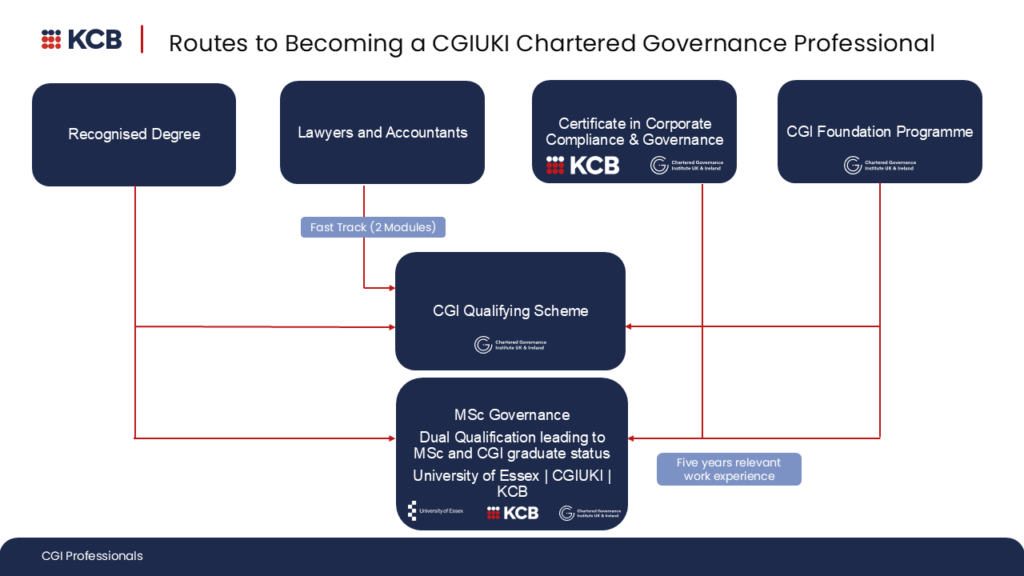
Graduates of the MSc Governance receive a qualification awarded by the University of Essex, and the programme is aligned with the professional standards of the Chartered Governance Institute UK & Ireland (CGIUKI), offering a strong foundation for those pursuing chartered status.

Entry criteria

Applicants should have:

  • A minimum of a 2:2 Bachelor’s degree (or international equivalent) in any discipline, OR
  • Affiliate status of the Chartered Governance Institute through an assessed programme of study, plus five years of relevant work experience

We particularly welcome applicants who have completed any of the following CGI certificate programmes:

  • Certificate in Corporate Compliance and Governance (Previously called Company Secretarial Practice and Share Registration Practice)
  • Certificate in Corporate Governance
  • Certificate in Academy Governance
  • Governance Officer Apprenticeship
  • Certificate in Charity Law and Governance

Applications for October 2026 are now open

If you’re ready to invest in your professional development and play a meaningful role in shaping good governance, we invite you to apply for the October 2026 intake. This is your opportunity to join a supportive, expert-led programme designed to help you grow, specialise, and succeed in the governance profession.

Email our Programme Manager, Lauren Devine, with your CV to apply today.

KCB and Belstar Training Centre join forces to strengthen governance education and training in Mauritius

As Mauritius continues to strengthen its position as an international financial centre, a new strategic partnership has been launched to further enhance governance education and professional training across the sector. Through a collaboration between Belstar Training Centre (Mauritius) and KCB Global (UK), programmes from the Chartered Governance Institute UK & Ireland (CGIUKI) will now become more accessible to Mauritian professionals.

The official signing of a Memorandum of Understanding between Belstar Training Centre and KCB Global took place on Thursday 7 May 2026 at Royal Green (Mauritus), in the presence of Jyoti Jeetun, Minister of Financial Services and Economic Planning, and Kaviraj Sukon, Minister of Tertiary Education, Science and Research. Also attending were Patrick Courtney, Head of Membership at CGIUKI, Tega Appavou, Chairman of Belstar Training Centre, and Neill McWilliams, KCB Programmes Director.

Under the partnership, KCB, the leading tuition provider for the CGIUKI Qualifying Programme, will work alongside Belstar Training Centre by providing its range of learning resources and experience to improve student outcomes and pass rates for CGIUKI programmes.

In addition, the partnership will introduce a new Certificate in Compliance & Corporate Governance, offering new entrants to the industry access to an internationally recognised qualification. Delivered through a hybrid learning model, the programme combines global expertise with local contextualisation and has been designed specifically to address an identified skills gap within the Mauritian market.

Tega Appavou, Chairman of Belstar Training Centre, commented:

“This partnership responds directly to the evolving needs of the financial services sector in Mauritius. As the country continues to strengthen its position as a compliant, transparent and internationally respected financial centre, there is a growing need to further develop governance education and professional capability.”

Neill McWilliams, Programme Director at KCB, added:

“Mauritius is an ambitious and fast-growing financial centre, and strengthening governance capability is essential to its continued success. We are delighted to partner with Belstar Training Centre to support the development of internationally recognised governance qualifications in Mauritius, helping professionals build their knowledge and skills.

By facilitating access to these programmes, Belstar Training Centre contributes to the development of a pool of local talent capable of meeting global standards, while supporting the country’s ambitions in good governance. Looking ahead, the prospects are equally promising. Belstar Training Centre aims to position Mauritius as a regional hub for governance training, with a natural progression for learners towards advanced programmes, including the Chartered Governance Qualifying Programme and specialised Master’s degrees. Ultimately, the success of this partnership will be measured by the market’s ability to absorb these newly trained professionals, the increase in certified practitioners, and the tangible improvement of governance practices across organisations.

By expanding access to CGIUKI programmes in Mauritius, Belstar Training Centre and KCB Global are strengthening governance as a driver of economic development in Mauritius and the region.

KCB’s Companion for Exam Success

All Qualifying Programme students at KCB have access to the Companion Examination Practice Tool. This powerful online revision platform is designed to build confidence through structured practice, instant feedback and clear progress tracking.

On 29 April, Company Law Tutor, Matt Mounsey, hosted a live webinar demonstrating how to use the Companion effectively to improve exam technique and boost scores ahead of the June exams.

What is the KCB Companion Examination Practice Tool?

The KCB Companion is an interactive exam preparation tool that allows students to practice past CGIUKI exam questions, with AI-generated feedback based on the CGIUKI official marking scheme.

It helps students identify knowledge gaps, refine exam technique, and track improvement over time. Students should use the Companion to:

  • Complete preset practice tests created by their tutor (and receive tutor feedback in addition to the AI)
  • Build & take personalised tests in ‘My Practice Tests’
  • Sit mock exams under timed conditions
  • Receive instant feedback to understand where and how to improve

These features make the Companion one of the most effective tools for structured CGIUKI exam revision.

How does the AI feedback work?

The Companion’s AI evaluates answers using the same principles applied in the CGIUKI official marking scheme. The feedback focuses on:  

  • The structure and clarity of your answer
  • Whether you applied the correct law or concept
  • How well you used the facts from the scenario
  • The strength and depth of your analysis

Because the tool has been trained on patterns from past marking schemes, and our Tutor feedback, you receive targeted, exam-specific guidance which will help you understand exactly what the examiners are looking for.

How to use the Companion to improve your exam scores  

When you take practice tests on the Companion, you’ll notice that your score is red, amber or green. These indicators are set to help you see which topics you need to work on, and work your way towards green scores to ensure you’re prepared and confident for the upcoming exams.

  • Green = strong understanding
  • Amber = needs refinement
  • Red = requires focused revision

If you find yourself achieving amber or red scores on a specific topic, you can manually create a ‘My Practice Test’ on the difficult topic, and answer all the questions in this area, allowing you to put your knowledge to the test and improve your answer structure by applying precise case studies or knowledge instead of listing everything you know. It’s important to ensure that you engage with the facts of the question, and give a clear, direct answer to what you’ve been asked, as opposed to what you want to answer.

A practical guide to integrate the Companion into your revision routine

  1. Start your morning with a system generated practice test. Go over it with the AI feedback
  2. Make a second test manually to focus on what you didn’t know or get right to hone your knowledge
  3. Spend a part of the afternoon going over the topics you didn’t understand by reviewing e-learning, your notes and lecture recordings before running another manual practice test
  4. Go over the AI feedback again and make notes of where you could improve your exam technique

Over time, you’ll see the scores shift towards green as your understanding and exam technique strengthen.

Watch the webinar

Click the video below to learn more about how to use the Companion effectively. If you have any questions about the Companion please contact us.

How to prepare effectively for your CGIUKI exams

With exam season fast approaching for students sitting the Chartered Governance Qualifying Programme and the CGIUKI Certificate in Corporate Compliance & Governance, we know many of you are balancing revision with full-time work, family commitments, and busy lives. For some, it may be a while since you last sat an exam, and that can feel daunting.

To help you prepare for with confidence, KCB has put together practical, realistic revision tactics for corporate governance students, designed especially for you to return to structed study.

Block out study time, and stick to it

Preparing for CGIUKI exams while managing a demanding job is challenging, but consistency will make the biggest difference. Setting aside just 30 minutes of focused revision each weekday can help build momentum without feeling overloaded. If you can spare a longer session at the weekend, even better. If you are particularly short for time, try and make some flash cards you can review on your commute to and from work to just keep your knowledge and understanding ticking over ahead of your exam.

Use whatever time you can dedicate to revisit areas where you feel less confident and gradually work through your session notes from lectures, the study text and past paper questions. Over time, these small, regular session will help you retain more information and develop a sense of calm confidence, knowing you’ve steadily put in the work. It’s recommended to set aside around 150 hours of revision for these exams in order to fully understand the content and improve your exam technique.

Practice exam questions

Practice remains the most effective revision technique for corporate governance exams. For Qualifying Programme students, the KCB Companion Examination Practice Tool is an invaluable resource. The Companion allows you to sit unlimited practice tests and mock exams, giving you instant, targeted feedback that highlights exactly where you’re performing well and where you need to focus more attention. Because the tool is aligned directly with the CGI exam marking scheme, you can be confident that you’re preparing in the same way examiners will assess you.

If you’d like a clearer understanding of how to use the KCB Companion to its full potential, you can watch the recording or our webinar: KCB’s Companion for Exam Success. In the recording, Matt Mounsey will walk you through how to utilise the Companion, how to interpret your feedback, and how to use it strategically in the final weeks before your exam. It’s a practical, supportive way to boost your confidence and strengthen your revision routine.

Make the most of your tutor

If you come across a concept that you don’t understand, or you’re unsure how to approach a particular past paper question, don’t hesitate to reach out to your tutor. They are here to support you and genuinely want you to succeed. A short email or quick call can often clear up confusion far more efficiently than trying to puzzle through it alone. Tutors can help you refine you exam technique, explain tricky areas of the study text, and offer reassurance when you’re feeling uncertain.

Take regular study breaks

Even the most motivated students can’t maintain deep concentration indefinitely. Research suggests that most people struggle to focus intensely for more than about 45 minutes at a time. For many students, the Pomodoro Technique is advises to break work into short, focused intervals of 25 minutes with a 5 minute break.

Building short breaks into your revision routine will help you stay fresh and absorb information more effectively. After each focused study session, take a few minutes to stretch, get some fresh air, make a cup of tea or grab a snack. If you’re dedicating a full day to revision, these breaks become even more important because they help you stay realistic, maintain energy, and avoid burnout.

Join a KCB Revision course for your programme

If you feel like you’d benefit from more structured support, KCB offers revision courses for every module of the Chartered Governance Qualifying Programme. These sessions focus on the key areas examiners prioritise and help you strengthen your understanding of the syllabus in a clear, targeted way.

Each course is led by an expert tutor who will guide you through high-value topics, exam-style questions, and effective answer structures. Many students find that attending a revision course helps everything “click”, especially in the final stretch before the exam.

If you want focused guidance, clearer direction, and a confidence boost ahead of exam day, a revision course can make a real difference to you preparation. You can see all the available revision courses here. Please note these are booked on a first come first serve basis and spaces are filling up.

Be confident

It’s completely normal to feel nervous if it has been years since your last exam, or even if you sat one last semester. It’s important to remember that you have more professional experience and maturity to draw upon. You’re studying a subject you’ve chosen, and you’re approaching it with the discipline and focus that comes from real‑world experience. Trust that you know more than you think, and allow that confidence to grow as you revise.

Launching KCB Flexible Lite – a smarter way to study using the study text

Many students preparing for Corporate Governance exams rely solely on the study text. Those who just use the study text often find it hard to motivate themselves due to it’s difficult and dense nature. Using the study text provides a solid starting point, however, we consistently see that students who combine the text with structured support feel more confident and achieve stronger exam results. When students are able to practice exam questions, and apply their knowledge in an exam context, not only do they feel more confident going into the exams, but they also achieve better exam results.

To support different learning styles and study needs, we are introducing KCB Flexible Lite, the sister programme to KCB Flexible.

KCB Flexible Lite is designed for students who prefer to study using the study text as their main learning resource. KCB Flexible Lite, available for £150, complements the study text by offering:

  • Video lectures for each chapter, breaking down key concepts
  • Knowledge check quizzes to reinforce understanding
  • Access to the KCB Companion Examination Practice Tool

The KCB Companion Examination Practice Tool enables you to practice examination questions and develop effective exam techniques, helping you build confidence, performance and readiness for the June exams. The KCB Companion has been instrumental in improving results and our students have left positive feedback about it, including:

“KCB Companion is really helpful to build an understanding of how to answer questions”

“The Companion tool has been a great resource so far”

“I love KCB Companion – it’s so helpful to identify my gaps in knowledge”

If you like studying at your own pace with the study text, but want some additional guidance and resources to help you revise, KCB Flexible Lite could be perfect for you. See the table below for a detailed breakdown of the difference between KCB Flexible and KCB Flexible Lite

KCB FlexibleKCB Flexible Lite
£300 £150
Personalised study scheduleStudy schedule
Video lectures covering all chaptersVideo lectures covering all chapters
Video lectures on how to approach the examVideo lectures on how to approach the exam
Knowledge quizzesKnowledge quizzes
KCB Companion toolKCB Companion tool
Drop-in sessions 
Tutor support 

As a charity, our mission is to support students in achieving their goals and passing their exams. KCB Flexible Lite has been created as an affordable alternative to our Flexible and Weekly classes, offering the extra structure and support many learners need beyond the study text. Register now for our KCB Flexible Lite modules below:

Company Compliance and Administration – Flexible Lite

Company Law – Flexible Lite

Corporate Governance – Flexible Lite

Interpreting Financial and Accounting Information – Flexible Lite

‘Standing Tall’: Redefining the role of the governance professional

In this week’s MSc Governance online class, led by Neill McWilliams, our cohort explored a topic that resonates across sectors: the evolving role and perception of the governance professional. It quickly became clear that in many organisations the role is still misunderstood or undervalued, despite its growing strategic importance.

This sparked a rich discussion about what governance professionals can do to shift that perception and strengthen the visibility, credibility, and impact of the profession. Below is a summary of the key themes that emerged:

Why the governance profession is still misunderstood

Across industries, governance roles are often associated narrowly with compliance, administration, or regulatory oversight. While these are important, they represent only a fraction of the value governance professionals bring.

Our cohort agreed: the profession must do more to articulate and demonstrate its strategic contribution, particularly in areas such as board effectiveness, risk management, organisational culture, and stakeholder engagement.

Standing Tall: Four pillars for strengthening the profession

Our discussion centered on what we titled ‘Standing Tall’, a mindset and approach built on four key pillars:

Diagram depicting the four key pillars of 'Standing Tall': 1. Developing increased self belief. 2. Demonstrate and report measurable impact. 3. Build influence. 4. Increase external visibility and network.

1. Developing increased self belief and confidence

Supporting boards, often composed of highly experienced individuals, can feel daunting. Yet governance professionals bring far more than regulatory expertise. We provide insight, challenge, perspective, and continuity. Recognising our own value is the first step toward ensuring others recognise it too.

2. Demonstrate and report measurable impact

Much of the work governance professionals do is intangible. That makes it easy for our contribution to go unnoticed.

We discussed the importance of making the invisible visible by clearly articulating how governance adds value. This includes:

  • Enhancing board effectiveness
  • Strengthening risk management
  • Improving decision‑making processes
  • Supporting ethical leadership
  • Enabling better stakeholder engagement

3. Build influence

Governance professionals are uniquely positioned at the intersection of boards, leadership teams, and organisational operations. By doing so, we move from being perceived as recorders of decisions to strategic enablers of them. Our influence grows when we are seen as integral to the decision-making process.

4. Increase external visibility and strengthen networks

Too often, governance professionals remain invisible outside their organisations. By building networks, sharing insights, publishing thought leadership, and contributing to industry conversations, we can collectively elevate the profile of the profession.

Join the conversation

Our MSc Governance cohort spans a wide range of sectors, and we are keen to continue this conversation with others in the field.

What are you views?

How can we further strengthen the perception and impact of governance professionals?

See our LinkedIn page where we welcome your insights, experiences, and perspectives.

International Women’s Day: Why gender diversity in governance still matters

International Women’s Day gives organisations an opportunity to reflect on progress and the work required to build fair, resilient and future-ready leadership structures. Governance sits at the heart of that conversation. At KCB, 81% of all of students identify as women. This is a figure we are incredibly proud of because we are committed to supporting the next generation of women leading corporate governance effectively and efficiently.

Recent insights from the FTSE Women Leaders Review indicate meaningful progress alongside areas where gender representation remains uneven. According to the FTSE Women Leaders Review, women now hold 43% of board positions across the FTSE 350, and account for 57% of Company Secretary roles. This signifies a positive shift in gender diversity strengthening the foundations of UK governance. However, women remain significantly underrepresented in the most influential executive roles, with the FTSE Women Leaders Review reporting that women hold just 8% of CEO positions in the FTSE 350.

A wide body of governance research suggests that boards with diverse perspectives tend to make stronger decisions, exercise more effective oversight, and deliver improved organisational performance. When a range of perspectives is present at the table, governance becomes more innovative and more attuned to risk. Effective governance depends on leaders who can navigate complexity, build trust, and make confident, well‑informed decisions. That requires widening the lens through which leadership potential is identified and developed. The FTSE Women Leaders Review also recommend that companies aim to appoint at least one woman in the in the key positions on the board, such as Chair, CEO, Financial Director, or Senior Independent Director, and emphasises the impact these roles have on strategy, culture and organisational change.

International Women’s Day is a reminder that representation is far more than a compliance exercise, but a strategic asset that shapes organisational resilience and credibility. The organisations that thrive will be those that build leadership teams reflective of the world they serve.

For women aspiring to step into these roles, now is the time to invest in your governance journey. Our programmes are designed to build confidence, capability, and the strategic insight needed to lead with impact. We want to help empower you to shape the future of governance.

KCB Flexible: Drop-in sessions that keep you motivated

KCB Flexible is now fully underway. We hosted our first drop‑in sessions this week, and have connected students with their tutors and peers. The sessions are informal, focused time where you can get quick answers, practical guidance, and a nudge in the right direction, without the commitment of a weekly class.

What happens in a drop‑in?

  • Bring your questions: course content, exam technique, study planning – we are here to help you on your study journey
  • Targeted guidance: tutors help you unblock sticking points in minutes and give guidance on how to focus your knowledge when it comes to revision
  • Peer momentum: hear what others are asking and learn faster, together
  • Companion walk‑throughs: get a live demo of our KCB Companion Examination Practice Tool so you can turn feedback into focused revision right away

What our KCB Flexible students have to say

If you’re still deciding whether or not to sign up for KCB Flexible, see some of our student feedback below:

“I struggled studying with just the study text, and due to the nature of my work,  I am unable to commit to a structured weekly programme. KCB Flexible is perfect for me.”

“I enjoy the flexibility in my studies, but at the same time I want to benefit from the support from a tutor and others in the same position. The regular ‘drop-in’ session and our WhatApp group really help in feeling part of study community.”

“I cannot recommend  KCB Flexible enough. It really meets my needs for my study approach. The programme is well structured and I enjoy watching the dedicated video lectures, rather than just recordings of class lectures in other providers programmes. The tutor support is excellent.” 

“The new KCB Companion examination practice tool within the programme is amazing!”

Why drop‑ins work for flexible learners

  • We recommend attending each drop-in session to gain clarity and discover deeper knowledge insights from your tutor
  • KCB Flexible is ideal if you’re balancing work, family and other commitments, and these drop-ins provide a great contact touch-point to meet your tutor and fellow learners
  • Leave each session feeling more confident with your questions answered, and knowing what your next step to exam success is

New to KCB Flexible? Watch our webinar

If you’d like to see the whole model in action, and get a deeper look at the Companion Examination Practice Tool, watch our recorded webinar from 17 February 2026. You’ll learn:

  • How the flexible tutoring model works and the kind of personalised support you’ll receive
  • How to target your revision with the Companion Tool’s instant feedback and progress tracking
  • How to combine drop‑ins + Companion for a tight loop of “practice → feedback → improvement

Watch the recording below or register for a flexible course

Meet our Tutor & Programme Leader: Neill McWilliams

Neill McWilliams is the Corporate Governance Tutor at KCB, teaching across both the Weekly and Flexible courses. In addition to his work on the Qualifying Programme, many students will also recognise Neill from his teaching on the Certificate in Corporate Compliance and Governance, as well as the MSc Governance, where he leads the Governance & Ethics module.

Neill’s career spans both industry and academia. He commenced his career at the Chartered Governance Institute (CGI), before leaving to found an e‑learning company that grew to become a leader in its field before being acquired by a major software provider in 2019. He has since pursued his passion for academia and is currently undertaking a PhD in Corporate Governance at Henley Business School in addition to working at KCB across all our programmes.

As a former member of the CGI Global Professional Standards Committee, Neill played a key role in maintaining the quality and consistency of CGI qualifications worldwide, while also advising on learning resources. A Fellow of the CGI, he is one of our most experienced tutors and is highly regarded for his dedication, expertise, and commitment to supporting students in achieving their goals.

What initially inspired you to pursue a career in governance, and how has that changed over time?

Neill: Early in my career, I worked for the Chartered Governance Institute (CGI) within the education department, and I think that’s where my first understanding of governance, and the impact that governance can have on organisations started. Whilst working at the CGI, I undertook the CGI Qualifying Programme and became a Chartered Governance Professional, and that was over 25 years ago. My interest in governance, I suppose, started then and has developed over time.

I founded and ran a company, so I can say with firsthand experience what the impact and value that good governance has within an organisation on its long-term sustainability and success.

Around fifteen years  ago, Ian Pirie, the KCB Founder, asked whether I would be interested in lecturing. At that time, it was face-to-face in a classroom. I really enjoyed it and found that I had a real interest in supporting CGI students in helping them prepare for their exams.

You’re currently undertaking a PhD at Henley Business School focused on Corporate Governance. How has this expanded your knowledge and experience in the sector?

Neill: I was interested in exploring governance from a range of different perspectives outside that of the Company Secretary. This provides a deeper understanding of governance and the real value that the Company Secretary is able to bring. My PhD research looks at the role of the Chair in board effectiveness and how contemporary governance challenges are impacting the role and importantly, the support that they need from the Company Secretary.

Do you see any emerging trends or challenges that governance professionals should be preparing for over the next five years or so?

Neill: The expectations that are place on the board have never been greater. Boards are operating in environments that are characterized by increased geopolitical instability, heighted cyber threats, persistent economic uncertainty, and at the same time, shareholders are demanding an increased attention to environmental, social governance issues, alongside high levels of engagement and transparency.

These increased expectations require a greater level of support from the company secretary, and it is critical for the Company Secretary to be able to demonstrate their value within the organization. I see my role as being more than supporting them in their exam preparation, but to support them in developing their careers.

You’ve been a tutor at KCB for 15 years. How would you describe your teaching style and approach to helping students achieve exam success? 

Neill: Having been a student myself, albeit a long time ago, I understand the challenges that students go though in undertaking the CGI qualifications.

I understand that our students undertake the qualifications part time, and will have already completed a full day of work when they come to our sessions. What I hope is that my passion for Corporate Governance and supporting students, alongside my practical background bring the classes to life.

Also, having been a lecturer for 15 years, and having previously worked for the CGI, I understanding what the examiner is looking for, so that I can be very focused and ensure that students valuable study time is well spent.

How have you found being a Tutor for both the Weekly and Flexible Qualifying Programme for your Corporate Governance module?

Neill: I really enjoyed recording and preparing the video lectures for KCB Flexible. I think this will provide a excellent alternative approach for those with work or family commitments and aren’t able to commit to weekly classes or for those outside of the UK who find it hard to meet our UK class times. I’m excited to support all students across both the Weekly and Flexible, and to meet the Flexible students in my drop in session or helping over emails or phone call. Similarly with Weekly students, I’m excited to get back into our weekly classes and start teaching and engaging with them in support of  the June exams.

If you could offer one piece of advice to students about to undertake their first Qualifying Programme exam, what would it be?

Neill: They should commence practicing examination questions early in their studies. Examination technique is absolutely critical. A student can have a great understanding of the knowledge, but being able to apply it in an examination is critical to success

Students are often apprehensive about the examination process, and so quite often delay practicing for too long. It’s for that reason that we developed the KCB Companion Examination Practice Tool to enable students to undertake exam practice and get immediate feedback and boost confidence.


If you would like to register for Neill’s Corporate Governance classes, click the links below.

Weekly Corporate Governance Classes | 4 – 6.30pm | Thursdays

Weekly Corporate Governance Classes | 6.15 – 8.45pm | Tuesdays

KCB Flexible | Corporate Governance