
Introducing KCB’s New Student Wellbeing Programme

For over 40 years, KCB has supported students through the challenges of the CGIUKI examinations. Of course, the route to becoming a Chartered Governance Professional is not easy, as it must ensure that those who achieve chartered status possess the technical knowledge required across a range of core disciplines. The high standard safeguards the credibility of the profession gives employers and stakeholders confidence in those who qualify. As a result, the study journey is demanding. CGIUKI recommends approximately 200 hours of study for each module. This includes the requirement to master the significant volume of material in the study text. For many students who have not studied for a number of years, they must readjust to the demands of study, whilst also adapting to the new demands of the online examination process.  Alongside their studies, most students are balancing these demands with the responsibilities of work and family

As the leading tuition provider for CGIUKI qualifications, chosen by more than half of all students using a provider, KCB recognises these challenges and continues to develop new initiatives and support services to meet the evolving needs of our students. In recent years, we have introduced:

  • our 40:20:40 approach to examination preparation, helping students make the most effective use of their study time;
  • our Flexible Study programmes, enabling students to balance their studies with other commitments; and
  • the KCB Companion Examination Practice Tool, providing students with additional opportunities to develop their examination technique and build confidence.

However, one issue that continues to emerge is the growing pressure on student wellbeing. We are seeing increasing levels of examination anxiety, declining confidence, guilt about sacrificing time with family while studying, and an overwhelming sense of “trying to hold everything together.”

Neill McWilliams, Programmes Leader at KCB, explains: “It’s in the nature of governance professionals to strive for excellence, and the way they approach their examinations is no different. This often creates unnecessary pressure, leading to increased stress that can affect not only their ability to study effectively, but also their performance in the workplace and family life.”

To provide further support to students, in September 2026, KCB is launching its Student Wellbeing Programme, designed to build confidence, promote a healthy perspective on studying and examinations, and equip students with the practical strategies they need to study effectively without compromising their wellbeing.

As part of the programme, KCB will deliver a three-part Student Wellbeing Webinar Series, designed specifically for CGIUKI students and presented in partnership with Heather Connery, an accredited coach and therapist, drawing on Gestalt, counselling, resilience and holistic wellbeing modalities, who has significant experience of balancing the demands of professional study. These sessions will blend practical study guidance with genuine wellbeing support. The webinars comprise the following:

1. The Resilient Professional Governance Student: Balancing Study, Work and Life

Date: 8 September 2026

Register here

This session helps students lay the foundations for success from the outset of their studies. It explores realistic approaches to study planning and time management, managing expectations and navigating the emotional demands of balancing professional study with work and personal commitments.

2. The Mid-Programme Challenge: Managing Workload, Confidence and Wellbeing

Date: 6 October 2026

Register here

For many students, this is the stage where confidence begins to falter. The initial momentum can give way to feelings of being overwhelmed, self-doubt and declining motivation. This webinar focuses on helping students regain control, rebuild confidence and momentum, and manage the guilt and pressure that often arise midway through their studies.

3. Understanding and Managing Anxiety for CGIUKI Examinations

Date: 3 November 2026

Register here

Examination anxiety affects many students and can have a significant impact on both wellbeing and performance. This session equips students with practical techniques to manage anxiety, stay focused under pressure, and approach the exam day with confidence, clarity and a positive mindset.

Alongside the webinar series, KCB is developing a dedicated counselling support pathway to ensure that students who require more personalised support can access professional guidance tailored to their individual needs.

We want to open this discussion to the wider governance community of tutors, students, employers, and professional bodies.

To that end, we would love to see your thoughts on LinkedIn and to hear from you. What did you find most challenging about balancing study with work and personal commitments, and what advice would you share with other students?
Governance‑Focused Employer Spotlight: How Flex Legal Is Developing Future Governance Talent

Flex Legal launched their award‑winning Company Secretary Trainee Scheme in 2024. The scheme supports aspiring governance professionals through a competitive assessment process, after which successful candidates are employed by Flex Legal and seconded into an in‑house governance team for two years. During this time, trainees study for their CGI Qualifying Programme modules with KCB as their education provider.

Trainees work day‑to‑day within their host organisations, gaining hands‑on experience in real governance environments. Current host companies include National Grid, NatWest, Centrica and others.

KCB is proud to partner with Flex Legal to deliver the academic element of the scheme, supporting trainees as they begin their governance careers.

As the first interview in our Governance-Focused Employer Spotlight, we were thrilled to speak with Ellie Murray-McNeive, Head of Talent at Flex Legal. Ellie has lead their Learning & Development (L&D) on the trainee schemes for nearly three years.

1. How does Flex Legal prepare trainees for working in governance environments, whether through training, mentoring, exposure to different teams, or structured development?

Flex runs a social mobility scheme that places Co Sec trainees on in-house secondments within top governance teams at impressive companies such as NatWest, Ford, and The Crown Estate. Legal and Co Sec trainees join either an autumn or spring cohort, kickstarting their journey with a three-week, in-person ‘Readiness Programme’ designed to develop the skills and knowledge needed for success. Across their two-year secondments, trainees study Part One of the Chartered Governance Qualifying Programme through KCB. They also benefit from coaching, study sessions, and a comprehensive cross-cohort Learning and Development (L&D) programme, alongside ample opportunities to network within their host companies and with fellow trainees.

2. Beyond their academic studies, what further L&D would trainees expect?

We collaborate with a fantastic network of Company Secretaries, governance teams, and social mobility advocates who generously volunteer their time to develop our trainees. Our cohorts have recently benefited from insightful sessions led by industry experts, including:

  • Amina Rasool (Co Sec at Ninety One) on Corporate Governance
  • Kako Mavalla (Governance for Good) on board minute writing
  • Mark Jenkins (Co Sec at Halma) on Boardroom Dynamics
  • Kerry Round and Jane Powell (Round Governance) on exam technique and key skills for successful juniors
  • Thelma Freeman (Deputy Co Sec at Nationwide) on communicating effectively with senior managers within a Co Sec team

3. Across the organisations you work with, what skills, behaviours, or mindsets tend to help early-career professionals succeed in governance roles?

A commercial mindset is hugely important; successful future trainees are genuinely interested in the financial and operational workings of companies and are motivated to see ‘behind the curtain’ of Board-level decisions. Resilience is another vital trait, as juggling professional studies alongside a full-time role requires determination and a strong work ethic. Finally, excellent communication skills and the ability to manage relationships effectively are absolutely crucial for any future Company Secretary.

4. How do junior colleagues typically contribute to governance when they join these in-house teams, and what kinds of responsibilities do they begin to take on early in their placements?

Our Co Sec trainees gain invaluable exposure to high-level work early in their secondments. Current trainees have actively contributed to preparing board packs and minutes, managing meeting logistics and action points, maintaining company registers, and handling Companies House filings. They also regularly assist with annual reports and the organization of AGMs.

5. From your perspective working closely with in-house Co Sec and governance teams, what does governance look like day-to-day inside the organisations your trainees support?

Across all the businesses we partner with, including FTSE 20 organisations, we see firsthand how closely Co Sec teams support daily operations well beyond standard company filings. The work is incredibly broad and dynamic; our trainees directly support vital decision-making functions and help ensure these organisations seamlessly meet their legal and regulatory obligations.

KCB and BEGA launch fully funded MSc Governance bursary

KCB, in partnership with the Black Excellence in Governance Awards (BEGA), is delighted to launch a fully funded bursary for one governance professional from a Black or Black heritage background.

KCB and BEGA are committed to increasing diversity and inclusion within the governance profession by creating opportunities that support the development of future leaders whose experiences and perspectives reflect the communities and organisations they serve.

Neill McWilliams, KCB Programme Leader commented “Diversity of backgrounds, perspectives, experiences and voices is a cornerstone of strong governance. At KCB, we are committed to fostering inclusivity across all our programmes, and we want to ensure that our MSc Governance is no exception. We are proud to partner with BEGA to support talented Black governance professionals in reaching their full potential and contributing to the future of the governance profession.”

Kako Mavalla, Convener of BEGA, commented: “One of BEGA’s core objectives is to create opportunities that extend beyond recognition and support the development of diverse pipeline of governance talent. We are delighted to partner with KCB to offer a life-changing bursary to a talented governance professional. By helping to remove barriers to world-class education in corporate governance, this initiative will equip the winner with the knowledge, skills and networks to thrive in the profession. We hope it is the first of many initiatives that help make governance more diverse, inclusive and representative of the communities we serve.”

The bursary will cover the full tuition fees for the MSc Governance programme, delivered by KCB in collaboration with the Chartered Governance Institute UK & Ireland (CGIUKI) and the University of Essex. This unique programme provides a dual qualification, enabling graduates to achieve both an MSc Governance and Graduate Membership (GradCG) of CGIUKI, with a pathway to Chartered status for those who meet the relevant professional experience requirements.

This is the first bursary scheme KCB has introduced for its MSc Governance programme, and we are actively developing further initiatives to ensure the programme is accessible to talented professionals from all backgrounds.

Application Process

The selection process consists of three stages:

  • Initial submission: Applicants submit their CV and a 500–750 word personal statement
  • Short essay stage: Eligible applicants will receive the short‑essay brief on 25 August and will have one week to submit a 300–500 word written response (2 September deadline)
  • Final selection: The top candidates will be invited to interview during the week commencing 15 September. The successful candidate will be notified by the end of September and will join the MSc Governance programme starting 14 October 2026. The bursary will be formally awarded at the BEGA Awards Ceremony on 15 October 2026

Who the Bursary is for

The bursary is open to applicants who:

  • Identify as being from a Black or Black‑heritage background
  • Are based in the United Kingdom for the duration of the programme
  • Applicants from all sectors are welcome to apply; however, priority will be given to those working in contexts where employer sponsorship for postgraduate study is not typically available, including the non-profit, charity, and voluntary sectors
  • Meet the academic entry requirements for the MSc Governance
  • Are able commit to part‑time study over two years

Why this matters

The governance profession plays a vital role in strengthening accountability, transparency and ethical leadership across organisations. By supporting talented individuals who may face barriers to postgraduate study, KCB and BEGA aim to contribute to a more inclusive and representative governance community.

How to apply

Applications are now open. Initial applications of your CV and Personal Statement will close on 18 August 2026.

Full details and submission instructions can be found below.

DateEvent
25 JuneApplications open to submit your CV and 500-750 word personal statement to sophie@kcbglobal.net
18 AugustDeadline for CV & personal statement submissions
25 AugustShort‑essay instructions sent to eligible applicants
2 SeptemberDeadline for 300–500 word short‑essay submissions
w/c 15 SeptemberInterviews with top 5 candidates
End of SeptemberFinal decision and winner notified
14 OctoberMSc Governance programme begins
15 OctoberBEGA Awards Evening

You can learn more about the MSc Governance programme with KCB here.

Student Experience: Confidence with the Certificate in Corporate Compliance & Governance

The Certificate in Corporate Compliance & Governance attracts professionals who want to deepen their understanding of governance practice and strengthen their impact at work. We spoke with Helen Cousen, a Relationship Manager, who completed the programme to build confidence, broaden her technical knowledge, and better support the organisations she works with. Helen won the Jack Wratten prize for best overall results, receiving a distinction on her Certificate.

Her reflections offer a grounded, honest look at what it’s like to study while working, the value of practical workshops, and the real-world skills she gained along the way. Helen’s experience is a strong example of how the Certificate can support career development for those working closely with governance, compliance, and company secretarial teams.

1. What motivated you to enroll in the Certificate in Corporate Compliance and Governance, and what were you hoping to achieve?

There are so many aspects to my day to day work in Share Registration and Employee Share Plans management that are fundamental to the Company Secretary role, but I felt that there were key elements missing in my knowledge in detailed governance and how the parts I saw daily combined with the overall job of Corporate Governance and Company Secretary. By completing this certificate, I wanted to close any gaps and equip myself to better support the companies and clients I work with.

2. What aspects of the teaching, content or structure did you particularly enjoy?

The online teaching, advanced scheduling and receiving the learning materials very early in the course allowed me to study within the confines of my day-to-day role and normal home life. I particularly enjoyed workshops with real life case studies and break out sessions with other students.

3. How has the Certificate supported your development in your current role, or influenced your career direction more broadly?

I am more confident in supporting my clients through corporate governance events, and better able to understand the demands of the Company Secretaries I work closely with.

4. Were there any particular skills, insights or moments during the course that you found especially valuable or confidence-building?

Finding and using source materials was a real key skill I developed during my study. Government agency websites are not known for their ease of use, and tips shared amongst our course cohort were especially helpful.

5. What would you say to someone considering joining the Certificate programme this October?

Do it! Providing you have time available to study and your employer’s support, it is definitely worth completing. Lots of useful insights and learning in the study material and workshops, as well as opportunities to make contact with others in similar roles


Helen’s journey highlights exactly what the Certificate is designed to deliver: practical knowledge, stronger professional confidence, and a clearer understanding of how governance principles apply in day‑to‑day roles. Her experience shows that with structured support, flexible online learning, and a collaborative cohort, students can successfully balance study with work and home life while gaining skills that make an immediate difference.

The Certificate offers not only technical insight, but also a community of peers and a pathway into further governance study and career progression.

If you would like to join our next cohort starting this October 2026, you can learn more and register here.

Routes to becoming a CGIUKI Chartered Governance Professional

Working in governance is central to how organisations operate effectively. From managing risk and maintaining trust to supporting key board functions, governance professionals provide the compliance expertise and strategic insight that organisations rely on. As regulatory environments become more complex, the profession increasingly demands strong judgement, technical knowledge, and the ability to navigate challenging situations with confidence.

The role and expectations have evolved. New governance professionals need the right training and qualifications to perform at their best. One of the most reliable ways to build this foundation is through structured governance education. The good news is that there are several routes to becoming a CGIUKI Chartered Governance Professional with KCB.

Below is a clear guide to help you identify the pathway that suits your background and goals.

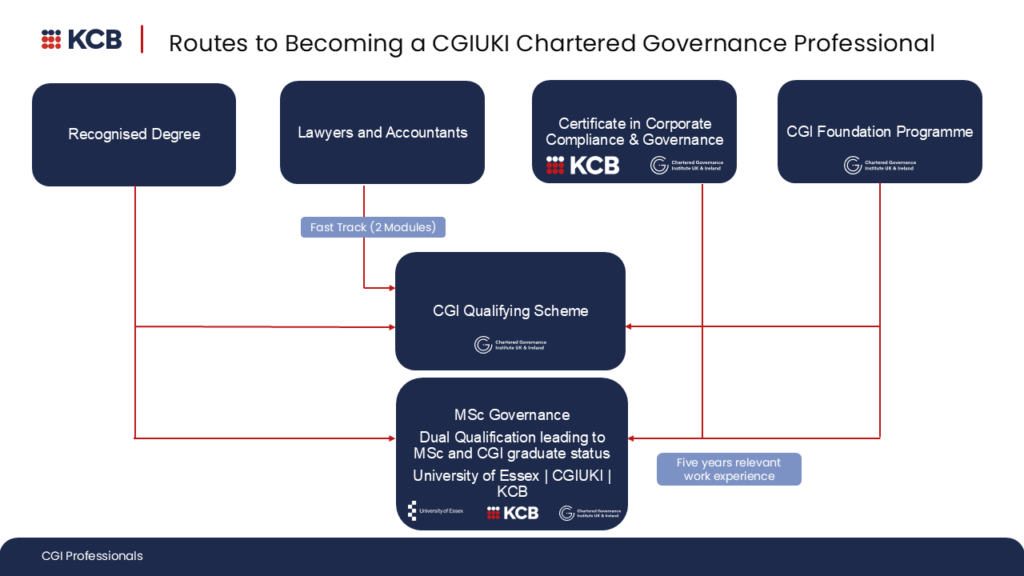
Flow chart of routes to becoming a CGIUKI Chartered Governance Professional.

I have a recognised degree

If you hold a university degree, you have two main routes:

1.      The CGIUKI Qualifying Programme (CGQP)

The CGQP consists of seven modules, with exams held every June and November. Students typically follow a 10‑week period of focused study for each module, combining structured learning, practice questions, and exam‑technique development. KCB supports students through flexible tuition options, including weekly live classes and flexible pathways.

2.     KCB’s MSc Governance (CGIUKI and University of Essex accredited)

Degree-holders can also apply for the part-time MSc Governance – a dual qualification that awards both an MSc and CGI Graduate (GradCG) status.

Delivered fully online over two years, the programme is increasingly popular for its practical approach, guest lecturers, and opportunities to connect with peers working across the governance profession. With only 25 students per intake, the programme provides a supportive, high‑quality learning experience where you can build your knowledge and pick up practical tips you can use immediately.

I’m a Lawyer or Accountant

Great news, you may be eligible for exemptions. Lawyers and accountants can fast‑track two modules of the CGIUKI Qualifying Programme, allowing you to progress more quickly toward chartered status.

I need to start from the beginning: what are my options?

If you don’t have a recognised degree, you can begin your governance journey through one of two entry routes:

1.      The CGI Foundation Programme

A broad introduction to governance, risk, and compliance, suitable for those completely new to the field.

2.     The CGIUKI Certificate in Corporate Compliance & Governance

KCB’s Certificate provides the essential knowledge and practical grounding needed to understand the core areas of corporate compliance and governance. Delivered over nine months (the next intake starts this October), it is designed to fit around full‑time work and personal commitments.

As a Level 4 qualification, equivalent to the first year of an undergraduate degree, it enables progression to the CGIUKI Qualifying Programme or, with five years of relevant experience, the MSc Governance.

Learn more

You can explore these routes in more detail at our upcoming webinar with the CGI on 16 June 2026 at 12pm BST. Register here.

The Benefits of the MSc Governance: What our students say

The MSc Governance has quickly become a programme our students genuinely enjoy, and not just for the qualification it leads to, but for the experience it offers along the way. Designed for working professionals, the MSc blends academic insight with practical, real‑world application, helping students build confidence, capability and a stronger professional identity from the very start.

Students tell us they value the programme’s interactive approach: guest lectures from experienced practitioners, hands‑on simulations, and opportunities to explore governance challenges through the lens of their own roles. This practical focus means they can apply what they learn immediately in their day‑to‑day work, making the programme feel relevant, engaging and impactful.

We also know that our students are balancing demanding schedules. The MSc Governance is delivered part‑time over two years, with one live online class each week and short breaks between modules. This structure allows students to progress steadily while managing work and personal commitments smoothly.

Most importantly, the feedback we receive highlights the sense of community, support and professional growth students experience throughout the programme. Here are some of the reflections they’ve shared with us:

What I value most about this MSc is that it builds on experience-based knowledge and helps me turn that into deeper, more critical understanding of governance, while also showing how brilliantly KCB puts the student at the centre of the learning experience.

Kevin Kelly, MSc Student (Feb 2026 cohort)

This program has been life changing for me. It’s the best decision I’ve ever made to embark on this particular path. Supportive tutors, eye opening guest speakers and authors, a real appreciation for open discussions – and on top of this I have built a network of supportive classmates. 
We come from a wide range of different governance fields, including Charity, Corporate, Housing, Financial, and it really cements the goal when you can learn about Governance across so many different sectors. It opens up a new world of understanding and opportunity. 
With such ease it has increased my confidence within my current role. A key driving theme throughout is understanding and recognising the value a Governance Professional brings to an organisation – and that value is enormous. 
Governance and Ethics are monumental – they’re everything.  With the right guidance, they become a simple, effective enabling force for organisational resilience.

Eliza Sharp, MSc Student (Feb 2026 cohort)

The MSc Governance programme has been a genuinely transformative experience. The curriculum strikes a rare balance between rigorous academic theory and real-world application and the quality of teaching and peer discussion has consistently pushed my thinking in new directions. I’d wholeheartedly recommend it to anyone looking to build a serious foundation in governance.

Natalija Rynkevic, MSc Student (Feb 2026 cohort)

The range of backgrounds and perspectives on the course has made for genuinely engaging and insightful sessions throughout.

Maria Malyan, MSc Student (Feb 2026 cohort)

Applications are now open for the October 2026 cohort. Click the link to learn more.

Foundation programme: Certificate in Corporate Compliance & Governance

If you’re considering a career change into governance, or want an introductory qualification in Corporate Compliance and Governance, the KCB Certificate in Corporate Compliance & Governance is one of the strongest and best recognised pathways into the profession.  

This 9-month foundation programme, starting October 2026, leads to a CGI-awarded Level 4 Certificate, the same academic level as a first year undergraduate degree. It’s designed to give you a practical, career-ready understanding of the core principles of Corporate Compliance and Governance, helping you begin or advance your career.

What is the Certificate in Corporate Compliance and Governance?

This is a foundation-level governance qualification that enables students to develop their careers, build on essential knowledge and enter the profession surrounding Corporate Compliance and Governance.

The programme consists of four modules:

  1. The Company
  2. Corporate Compliance and Administration
  3. Corporate Governance
  4. Meetings

Through a mix of live online lectures (delivered via Zoom), e-learning and private study using the dedicated study manual and other recommended reading, you will sit one assessment for each module.

  1. The Company: 2500-3000 word assignment
  2. Corporate Compliance and Administration: 2 hour examination
  3. Corporate Governance: 2500-3000 word assignment
  4. Meetings: 2500-3000 word assignment

The assignment structure builds confidence for those who may later progress to the MSc Governance, which grants CGI status, as well as a Master’s accredited by the University of Essex.

Key benefits

The benefits of taking the Certificate Programme include:

  • Fewer exams and accessible assessments
  • Practical, real-world examples you can apply immediately in your role
  • Expert lectures who support you throughout the programme
  • One live class a week, giving you flexibility to fit around your job and life
  • Only 9 months long, making it manageable and efficient route into the field

How do I apply?

You can register directly on our website. If you would like more information, contact our Programme Manager, Lauren Devine.

The next enrollment is October 2026. Exact dates will be announced shortly.

KCB’s Guide to Effective Revision

With the CGIUKI exams just around the corner, now is the time to focus on effective revision. To support students preparing for the upcoming sitting, Programme Director, Neill McWilliams, recently delivered a webinar packed with practical guidance, revision strategies and exam-focused tips.

The 40-20-40 revision approach

Neill’s presentation introduced KCB’s 40-20-40 approach. This structured method is designed to help students build confidence and prepare thoroughly for the exams. This combined approach, aiming for 120-200 hours of revision, ensures a balanced plan that strengthens both knowledge and exam technique. The 40-20-40 approach helps you deepen your knowledge and understanding across the syllabus, and gives you the ability to apply this knowledge and understanding to the exam questions. Included in the hours of revision is a great deal of practice – this is the key to success.

Through developing exam technique, familiarising yourself with the examiners approach, reaffirming knowledge gaps, you will improve your confidence and time management skills, leading to higher pass rates.

Higher pass rates with KCB

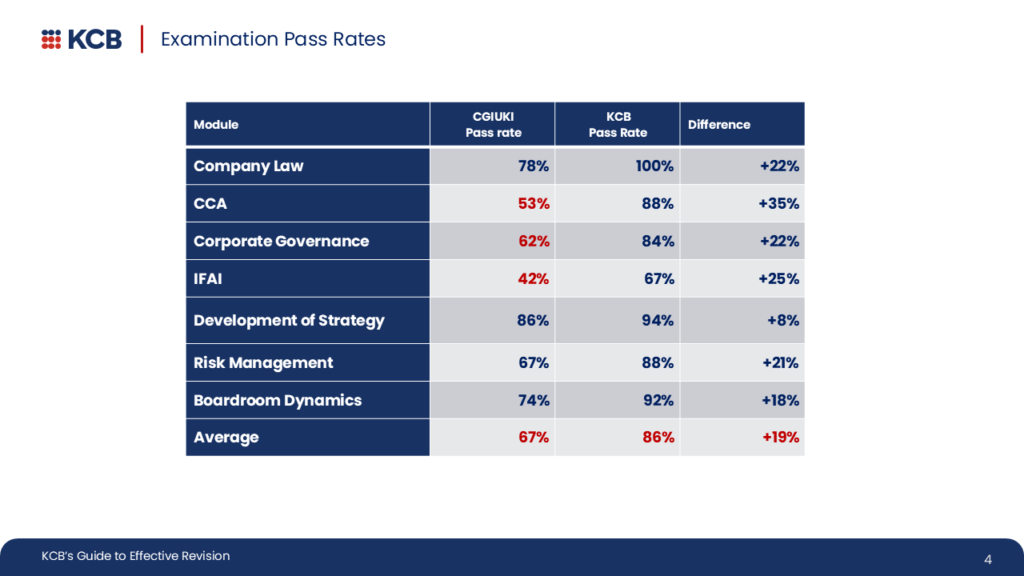
KCB is proud to maintain higher than average pass rates. Last semester we had an average pass rate of 87% across all our modules, ranging from 8% – 35% higher than the standard CGI pass rates. These results demonstrate that KCB’s structured approach genuinely supports student success.

What are the examiners looking for?

One of the most common challenges students face is writing down everything they know rather than answering the question asked. Examiners want to see:

  • Clear understanding of the syllabus
  • The ability to apply knowledge to specific scenarios
  • Answers pitched at the right level
  • Strong exam technique and structured responses

These skills are developed through targeted practice, not passive reading.

How should I develop my revision schedule?

With only a few weeks left before the exams, it’s important to create a revision plan that is realistic, achievable, and fits around your work and personal commitments.

Here’s a simple structure to follow:

  1. Identify the exam questions you want to attempt
  2. Create a realistic practice schedule and stick to it
  3. Use the KCB Companion Examination Practice Tool to complete practice questions
  4. Review your notes before attempting questions
  5. After completing them, compare your answers with the CGI marking scheme
  6. Use the feedback to refine your technique and strengthen weaker areas

If you’re new to the Companion tool, you can watch our previous webinar for a full walkthrough.

Want to learn more?

You can watch Neill’s full webinar below for deeper insights into how to prepare effectively for next month’s exams.

If you have questions or would like additional support, reach out to your KCB tutor, or click the link to register and gain access to our KCB Flexible Lite programme, which includes helpful resources and full access to the KCB Companion Examination Practice Tool.

Applications now open: launching the MSc Governance for October 2026

We’re delighted to announce that applications are now open for the October 2026 intake for the MSc Governance, a specialist postgraduate programme designed for professionals who want to deepen their governance expertise, strengthen their practical skills, and advance their careers in a rapidly evolving sector.

As organisations across corporate, public, and not-for-profit environments face increasing expectations around accountability, transparently and effective decision-making. The demand for skilled governance professionals continues to grow. The MSc Governance has been created to meet this need, offering a structured, academically rigorous, and professionally relevant route to career progression.

Why the MSc Governance?

This two-year, part-time programme provides a comprehensive grounding in goverance, risk, compliance, organisational leadership, and strategic oversight. Students explore key governance topics in depth, developing specialist knowledge and applying their learning directly to real-world professional contexts.

The programme is delivered by our expert tutors at KCB. With over 40 years of experience in delivery governance qualifications, our tutors combine academic expertise with extensive practitioner experience, ensuring that students benefit from both theoretical insights and practical application.

Designed for working professionals

The MSc Governance is delivered online, making it accessible to professionals balancing work, study and personal commitments. Each module includes:

  • 10 weekly live online sessions delivered via Zoom
  • Guided independent study to deepen understanding
  • High-quality learning resources via the learning management system

Students also benefit from in-person learning opportunities aligned with CGIUKI events. Details for the October 2026 cohort will be confirmed in line with upcoming conference schedules and programme planning.

Small cohorts, personalised support

To ensure a high-quality learning experience, each intake is limited to 25 students. This small-cohort model allows for meaningful interaction, personalised academic support, and a strong sense of communication, all of which contribute to student success.

Who is the programme suitable for?

The MSc Governance is ideal for:

  • Experienced governance professionals seeking to formalise and deepen their expertise
  • Early-career professionals looking to build strong foundational knowledge
  • Individuals working in corporate, public and not-for-profit organisations
  • Anyone aspiring to progress into governance, compliance or organisational leadership roles

Whether you’re looking to enhance your current role or transition into a governance-focused career, this programme provides a clear and credible pathway.

A dual-qualification pathway

Graduates of the MSc Governance receive a qualification awarded by the University of Essex, and the programme is aligned with the professional standards of the Chartered Governance Institute UK & Ireland (CGIUKI), offering a strong foundation for those pursuing chartered status.

Entry criteria

Applicants should have:

  • A minimum of a 2:2 Bachelor’s degree (or international equivalent) in any discipline, OR
  • Affiliate status of the Chartered Governance Institute through an assessed programme of study, plus five years of relevant work experience

We particularly welcome applicants who have completed any of the following CGI certificate programmes:

  • Certificate in Corporate Compliance and Governance (Previously called Company Secretarial Practice and Share Registration Practice)
  • Certificate in Corporate Governance
  • Certificate in Academy Governance
  • Governance Officer Apprenticeship
  • Certificate in Charity Law and Governance

Applications for October 2026 are now open

If you’re ready to invest in your professional development and play a meaningful role in shaping good governance, we invite you to apply for the October 2026 intake. This is your opportunity to join a supportive, expert-led programme designed to help you grow, specialise, and succeed in the governance profession.

Email our Programme Manager, Lauren Devine, with your CV to apply today.

KCB and Belstar Training Centre join forces to strengthen governance education and training in Mauritius

As Mauritius continues to strengthen its position as an international financial centre, a new strategic partnership has been launched to further enhance governance education and professional training across the sector. Through a collaboration between Belstar Training Centre (Mauritius) and KCB Global (UK), programmes from the Chartered Governance Institute UK & Ireland (CGIUKI) will now become more accessible to Mauritian professionals.

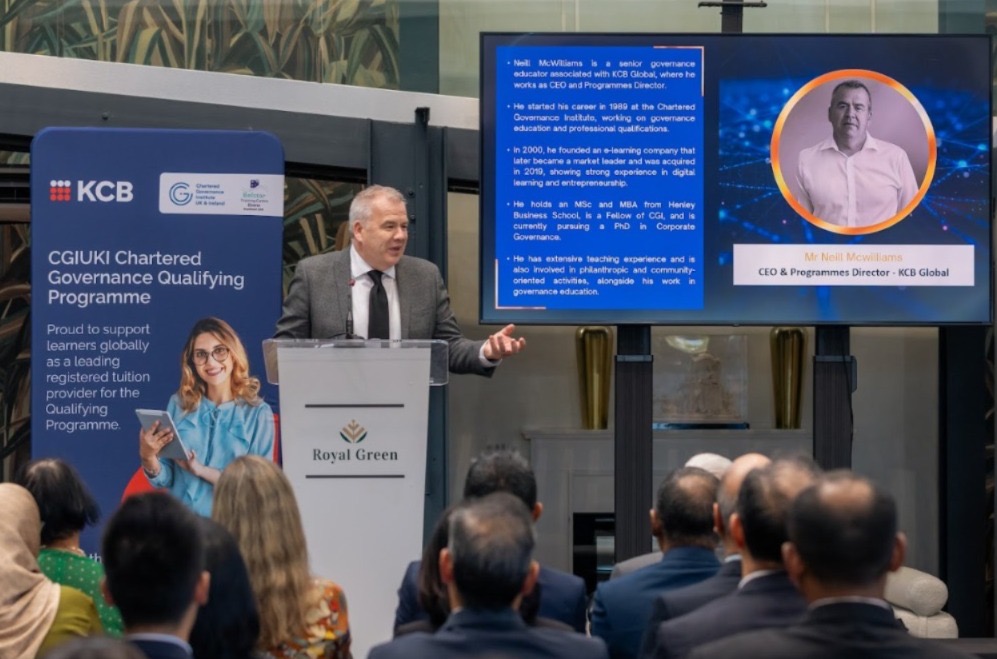
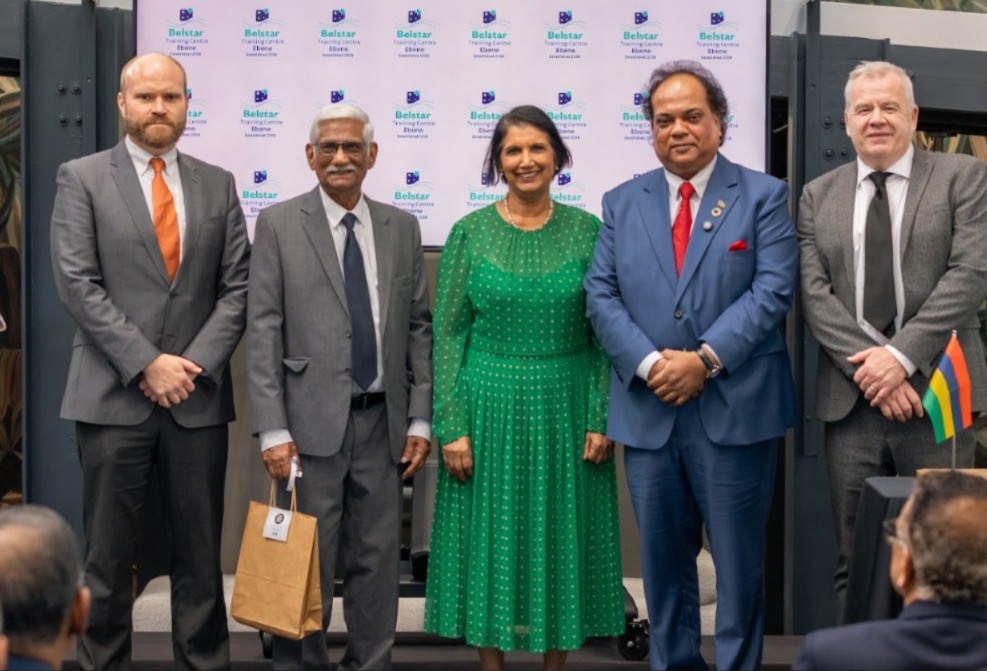
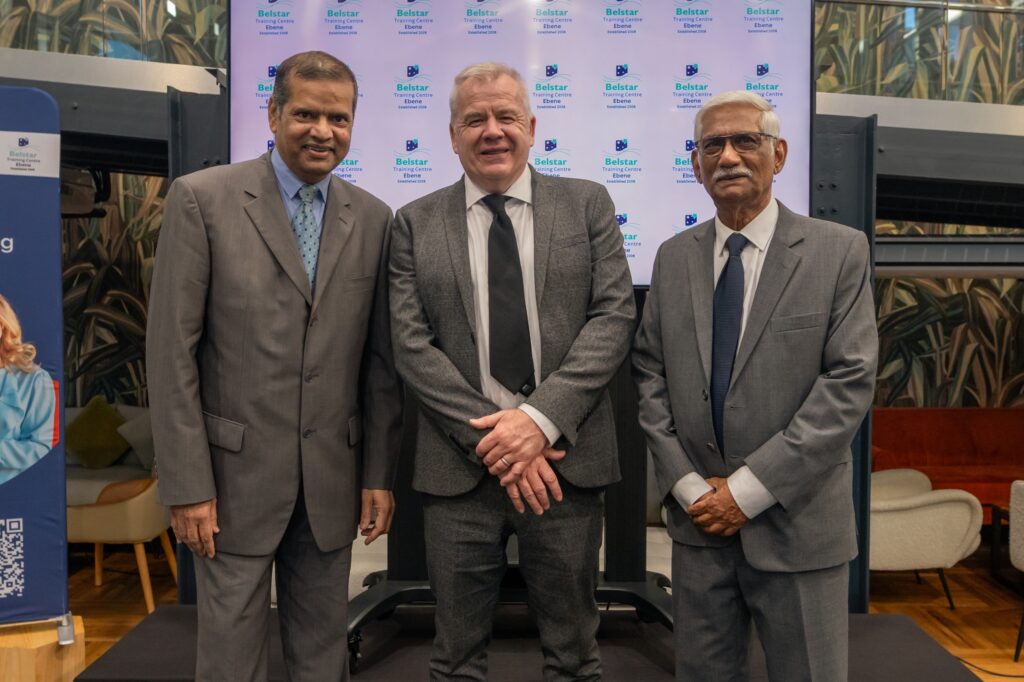
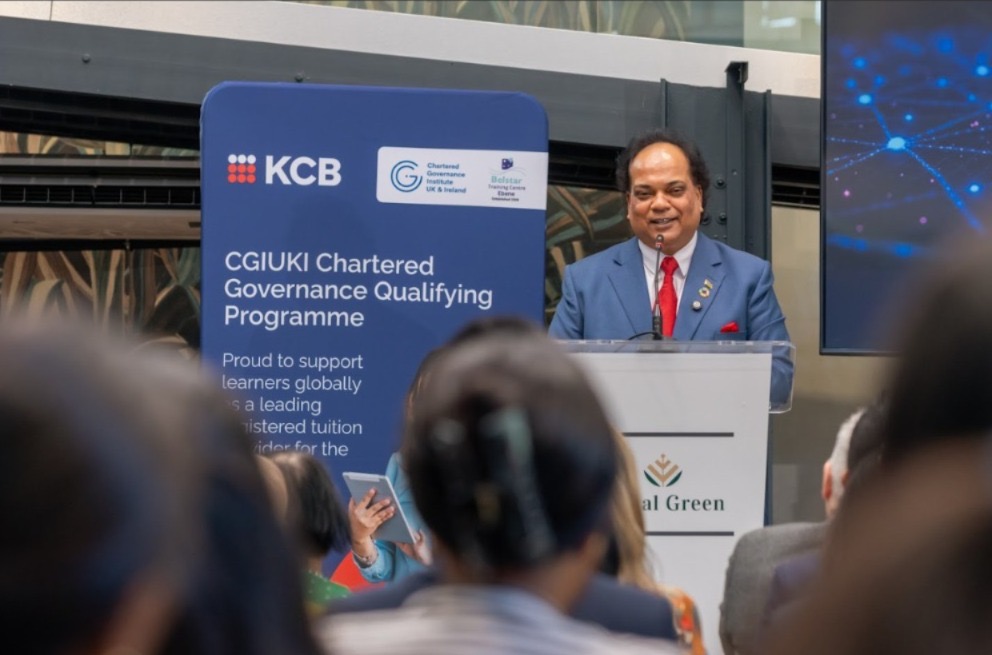
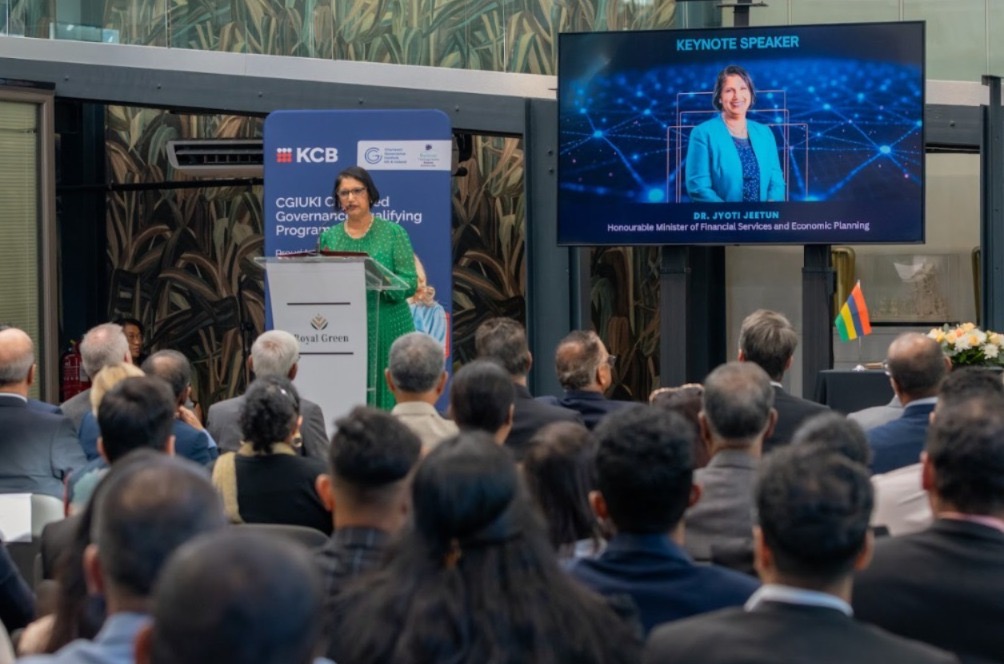
The official signing of a Memorandum of Understanding between Belstar Training Centre and KCB Global took place on Thursday 7 May 2026 at Royal Green (Mauritus), in the presence of Jyoti Jeetun, Minister of Financial Services and Economic Planning, and Kaviraj Sukon, Minister of Tertiary Education, Science and Research. Also attending were Patrick Courtney, Head of Membership at CGIUKI, Tega Appavou, Chairman of Belstar Training Centre, and Neill McWilliams, KCB Programmes Director.

Under the partnership, KCB, the leading tuition provider for the CGIUKI Qualifying Programme, will work alongside Belstar Training Centre by providing its range of learning resources and experience to improve student outcomes and pass rates for CGIUKI programmes.

In addition, the partnership will introduce a new Certificate in Compliance & Corporate Governance, offering new entrants to the industry access to an internationally recognised qualification. Delivered through a hybrid learning model, the programme combines global expertise with local contextualisation and has been designed specifically to address an identified skills gap within the Mauritian market.

Tega Appavou, Chairman of Belstar Training Centre, commented:

“This partnership responds directly to the evolving needs of the financial services sector in Mauritius. As the country continues to strengthen its position as a compliant, transparent and internationally respected financial centre, there is a growing need to further develop governance education and professional capability.”

Neill McWilliams, Programme Director at KCB, added:

“Mauritius is an ambitious and fast-growing financial centre, and strengthening governance capability is essential to its continued success. We are delighted to partner with Belstar Training Centre to support the development of internationally recognised governance qualifications in Mauritius, helping professionals build their knowledge and skills.

By facilitating access to these programmes, Belstar Training Centre contributes to the development of a pool of local talent capable of meeting global standards, while supporting the country’s ambitions in good governance. Looking ahead, the prospects are equally promising. Belstar Training Centre aims to position Mauritius as a regional hub for governance training, with a natural progression for learners towards advanced programmes, including the Chartered Governance Qualifying Programme and specialised Master’s degrees. Ultimately, the success of this partnership will be measured by the market’s ability to absorb these newly trained professionals, the increase in certified practitioners, and the tangible improvement of governance practices across organisations.

By expanding access to CGIUKI programmes in Mauritius, Belstar Training Centre and KCB Global are strengthening governance as a driver of economic development in Mauritius and the region.