KCB Flexible: Drop-in sessions that keep you motivated

KCB Flexible is now fully underway. We hosted our first drop‑in sessions this week, and have connected students with their tutors and peers. The sessions are informal, focused time where you can get quick answers, practical guidance, and a nudge in the right direction, without the commitment of a weekly class.

What happens in a drop‑in?

  • Bring your questions: course content, exam technique, study planning – we are here to help you on your study journey
  • Targeted guidance: tutors help you unblock sticking points in minutes and give guidance on how to focus your knowledge when it comes to revision
  • Peer momentum: hear what others are asking and learn faster, together
  • Companion walk‑throughs: get a live demo of our KCB Companion Examination Practice Tool so you can turn feedback into focused revision right away

What our KCB Flexible students have to say

If you’re still deciding whether or not to sign up for KCB Flexible, see some of our student feedback below:

“I struggled studying with just the study text, and due to the nature of my work,  I am unable to commit to a structured weekly programme. KCB Flexible is perfect for me.”

“I enjoy the flexibility in my studies, but at the same time I want to benefit from the support from a tutor and others in the same position. The regular ‘drop-in’ session and our WhatApp group really help in feeling part of study community.”

“I cannot recommend  KCB Flexible enough. It really meets my needs for my study approach. The programme is well structured and I enjoy watching the dedicated video lectures, rather than just recordings of class lectures in other providers programmes. The tutor support is excellent.” 

“The new KCB Companion examination practice tool within the programme is amazing!”

Why drop‑ins work for flexible learners

  • We recommend attending each drop-in session to gain clarity and discover deeper knowledge insights from your tutor
  • KCB Flexible is ideal if you’re balancing work, family and other commitments, and these drop-ins provide a great contact touch-point to meet your tutor and fellow learners
  • Leave each session feeling more confident with your questions answered, and knowing what your next step to exam success is

New to KCB Flexible? Watch our webinar

If you’d like to see the whole model in action, and get a deeper look at the Companion Examination Practice Tool, watch our recorded webinar from 17 February 2026. You’ll learn:

  • How the flexible tutoring model works and the kind of personalised support you’ll receive
  • How to target your revision with the Companion Tool’s instant feedback and progress tracking
  • How to combine drop‑ins + Companion for a tight loop of “practice → feedback → improvement

Watch the recording below or register for a flexible course

Meet our Tutor & Programme Leader: Neill McWilliams

Neill McWilliams is the Corporate Governance Tutor at KCB, teaching across both the Weekly and Flexible courses. In addition to his work on the Qualifying Programme, many students will also recognise Neill from his teaching on the Certificate in Corporate Compliance and Governance, as well as the MSc Governance, where he leads the Governance & Ethics module.

Neill’s career spans both industry and academia. He commenced his career at the Chartered Governance Institute (CGI), before leaving to found an e‑learning company that grew to become a leader in its field before being acquired by a major software provider in 2019. He has since pursued his passion for academia and is currently undertaking a PhD in Corporate Governance at Henley Business School in addition to working at KCB across all our programmes.

As a former member of the CGI Global Professional Standards Committee, Neill played a key role in maintaining the quality and consistency of CGI qualifications worldwide, while also advising on learning resources. A Fellow of the CGI, he is one of our most experienced tutors and is highly regarded for his dedication, expertise, and commitment to supporting students in achieving their goals.

What initially inspired you to pursue a career in governance, and how has that changed over time?

Neill: Early in my career, I worked for the Chartered Governance Institute (CGI) within the education department, and I think that’s where my first understanding of governance, and the impact that governance can have on organisations started. Whilst working at the CGI, I undertook the CGI Qualifying Programme and became a Chartered Governance Professional, and that was over 25 years ago. My interest in governance, I suppose, started then and has developed over time.

I founded and ran a company, so I can say with firsthand experience what the impact and value that good governance has within an organisation on its long-term sustainability and success.

Around fifteen years  ago, Ian Pirie, the KCB Founder, asked whether I would be interested in lecturing. At that time, it was face-to-face in a classroom. I really enjoyed it and found that I had a real interest in supporting CGI students in helping them prepare for their exams.

You’re currently undertaking a PhD at Henley Business School focused on Corporate Governance. How has this expanded your knowledge and experience in the sector?

Neill: I was interested in exploring governance from a range of different perspectives outside that of the Company Secretary. This provides a deeper understanding of governance and the real value that the Company Secretary is able to bring. My PhD research looks at the role of the Chair in board effectiveness and how contemporary governance challenges are impacting the role and importantly, the support that they need from the Company Secretary.

Do you see any emerging trends or challenges that governance professionals should be preparing for over the next five years or so?

Neill: The expectations that are place on the board have never been greater. Boards are operating in environments that are characterized by increased geopolitical instability, heighted cyber threats, persistent economic uncertainty, and at the same time, shareholders are demanding an increased attention to environmental, social governance issues, alongside high levels of engagement and transparency.

These increased expectations require a greater level of support from the company secretary, and it is critical for the Company Secretary to be able to demonstrate their value within the organization. I see my role as being more than supporting them in their exam preparation, but to support them in developing their careers.

You’ve been a tutor at KCB for 15 years. How would you describe your teaching style and approach to helping students achieve exam success? 

Neill: Having been a student myself, albeit a long time ago, I understand the challenges that students go though in undertaking the CGI qualifications.

I understand that our students undertake the qualifications part time, and will have already completed a full day of work when they come to our sessions. What I hope is that my passion for Corporate Governance and supporting students, alongside my practical background bring the classes to life.

Also, having been a lecturer for 15 years, and having previously worked for the CGI, I understanding what the examiner is looking for, so that I can be very focused and ensure that students valuable study time is well spent.

How have you found being a Tutor for both the Weekly and Flexible Qualifying Programme for your Corporate Governance module?

Neill: I really enjoyed recording and preparing the video lectures for KCB Flexible. I think this will provide a excellent alternative approach for those with work or family commitments and aren’t able to commit to weekly classes or for those outside of the UK who find it hard to meet our UK class times. I’m excited to support all students across both the Weekly and Flexible, and to meet the Flexible students in my drop in session or helping over emails or phone call. Similarly with Weekly students, I’m excited to get back into our weekly classes and start teaching and engaging with them in support of  the June exams.

If you could offer one piece of advice to students about to undertake their first Qualifying Programme exam, what would it be?

Neill: They should commence practicing examination questions early in their studies. Examination technique is absolutely critical. A student can have a great understanding of the knowledge, but being able to apply it in an examination is critical to success

Students are often apprehensive about the examination process, and so quite often delay practicing for too long. It’s for that reason that we developed the KCB Companion Examination Practice Tool to enable students to undertake exam practice and get immediate feedback and boost confidence.


If you would like to register for Neill’s Corporate Governance classes, click the links below.

Weekly Corporate Governance Classes | 4 – 6.30pm | Thursdays

Weekly Corporate Governance Classes | 6.15 – 8.45pm | Tuesdays

KCB Flexible | Corporate Governance

Meet our KCB Tutor: Matthew Doyle

KCB is excited to welcome Matthew Doyle as the new Development of Strategy Tutor for the Chartered Governance Qualifying Programme. Matthew will also be teaching one of our Risk Management Qualifying Programme classes. As an expert in governance, strategic decision making and organisational risk, Matthew brings industry-leading insight into these modules, offering students a comprehensive perspective across both risk and strategy.  

Matthew brings a unique blend of board-level experience, academic insight and real-world adventure to the classroom. His career spans governance roles across the UK and US, lecturing at institutions such as Cox Business School, and working within the ESG (Environment, Social and Governance) space for a major asset manager. Alongside his professional expertise, Matthew is also an avid adventurer, drawing on extreme environments to deepen his understanding of risk, decision-making and strategy.

If you would like to register for Matthew’s Development of Strategy class, click here.

If you would like to register for Matthew’s Risk Management class, click here.

What initially inspired you to pursue a career in governance and risk, and how has that motivation evolved over time?

Matthew: I remember having my first board role, and up until that point in time, I hadn’t really thought about risk and governance. I remember people saying that ‘we can’t do this or that’ and ‘this is bad governance’. I wasn’t experienced enough to challenge it, so I went and thought about it. I learnt about governance and how it works, the rules, principles and outcomes. From this I learnt that a lot of people don’t understand what governance is, particularly good governance. That was my starting point.

I worked for a big asset manager in their ESG (Environment, Social and Governance) group. I joined having a strong interest in the environment and what corporates and investors were doing in this space, including societal work. When I started, for want of a better term, I wasn’t really thinking about governance. Then one day I sort of had this epiphany moment, which sounds silly, but I thought, if you implement good governance, the environmental and social aspects will happen automatically. I asked myself, ‘why are we spending all this time worrying about the environmental and societal issues, when, if we get the governance right, they will become self-evident, these are the things we should be doing.’

You’re quite an avid adventurer. How do you think those experiences contribute to your knowledge surrounding risk and strategy?

I think it gives you a very different perspective. The view of having everything on the line makes you look at things differently. I work on the board of a financial services company and the compliance people are amazing. They know their stuff back to front but they don’t have the perspective that the CEO has, or the directors. Or for that matter, someone who’s been on the side of a mountain at -30°c and is thinking ‘It’s dark, I can’t see where I’m going. How am I going to get out of this? What are my options? Where am I going?’ You’re running through those different risks and I find that, whether in a boardroom or chattering or a CEO about risk and strategy and governance, you understand the fact that you’re the person who is going to own the decision, whether it succeeds or fails.

Extreme sports, because they’re so dangerous, have a lot of governance (i.e. controls). They’re actually quite similar to the corporate world, because you’re putting a lot on the line. Ultimately it’s up to you to make sure you succeed.

It also helps people who aren’t senior answer questions a bit more specifically, and those who are senior will better understand that perspective. Doing extreme sports and being an adventurer helps you better qualify and understand strategy, governance and risk. Just as those who work on a board need to understand these dimensions to make decisions effectively.

Given your wide range of real‑world experiences in risk and strategy, how will you draw on these to help students understand the governance concepts behind them?

It is those real world experiences that bring governance to life. It’s about making decisions, about managing businesses where it’s gone well, and where it hasn’t. By using real life examples, whether it’s from their work or things going on in current affairs, it will hopefully bring risk management & developing strategy concepts to life for my students.

Because I’m really interested in governance, I’ve done lots of research into it. I am looking forward to bringing examples to light and discussing specific concpets and interests, and my perspective and experience in class. Governance is abstract, but talking about it in terms of things students will understand or have experience in, will help them better understand concepts to take into their exams, making them feel more confident and prepared.

Sometimes, if a particular concept is hard to grasp, or I can see interest waning, I do a role play with them. Even if it’s a bit abstract, you can always make it a bit of fun, and get the students making the decisions. Then we can talk though their choices, the different challenges of the situation and what they could do differently.

There was a show in Australia, called Hypothetical, by Jeffery Robinson. It was basically a show about governance. He was great at getting people to talk about decisions and decision making processes. I’ve sort of used this as a template to get students to think, ‘how are you going to make that decision?’ By giving real life experiences, and letting them role play I hope it will allow them to see why they are making decision in that particular way, or think about it in a different way to help them make sense of risk management.

One of the things I find interesting during these role plays, is being told what isn’t working. And that’s exactly what should happen, because then you can unpack it and explain. Quite often it’s because they don’t understand what’s actually happening in the boardroom, and that’s common – people don’t fully understand the role of the board. So then we talk about the role of the board, and they see that the board hasn’t done anything wrong, but they didn’t have the right information to make a good decision. The board is only as good as the information they’re provided. So if the information isn’t getting through, then that’s a governance issue. The issue isn’t that boards make bad decisions. The issue is bad governance and that the board needs to make decisions with information that isn’t getting through to them, to make good decisions.

This applies equally at all level of management.

If you could offer one piece of advice to students about to take their first CGQP exam, what would it be?

Listen to the other people in your class as you will learn so much from it. You will learn as much, if not more, from the other people in the room as you will from your Tutor. If there are 20 people in your class, that’s 20 other views, 20 other experiences you can draw on and learn from. Whether you’re taking my Development of Strategy of Risk Management Class, learning and taking in other peoples views and real world experiences will help deepen your understanding of governance concepts.

By the time you’re in the exam, you will be prepared. You have the knowledge, and you just need to put it into motion and be clear in your answers. The KCB Companion Examination Practice Tool will have given you the time to practice in exam conditions, and the advice you need to improve (from me and the AI) so hopefully by the time you’re in the real thing, you will feel calm, prepared and ready to ace the exam!


If you’d like to register for Matthew’s Development of Strategy class, click here, or register for his Risk Management class here.

Helping students achieve excellence in exams: KCB’s Companion Examination Practice Tool

Preparing for the Qualifying Programme exams requires more than understanding the syllabus. Success also depends on mastering exam technique. To support our students in developing both knowledge and exam skills, we created KCB’s Companion Examination Practice Tool. This intuitive, AI-supported tool is designed to boost performance and build confidence.

All students enrolled on our Qualifying Programme tuition courses, including Weekly, Flexible and Revision, receive exclusive access to this powerful new resource to ensure confidence with improved examination skills.

The Companion provides students with an immediate examination mark, generated using both the CGI study text and the official CGI marking scheme. Drawing on these sources, the AI delivers detailed feedback that highlights strengths, identifies weaknesses, and pinpoints any missing elements in the answer. This allows students to instantly see where their responses need improvement and where their knowledge can be strengthened. The AI’s marking and feedback are then supplemented by the tutor, who builds on the AI’s insights to continually improve the marking capabilities, in addition to giving additional guidance to students.

Based on our pilot results, the Companion is proving to be a game-changer, heling students achieve distinctions, merits and significantly higher pass rates.

Pilot results: How did our students perform?

In the November 2025 exam season, we ran a trial with students on the Corporate Governance and Company Law modules. The results clearly show how effective the Companion is in improving exam outcomes.

Corporate Governance Module

  • 83% of students who used it passed  
  • 6 distinctions
  • 3 merits

Company Law Module

  • 100% of students who used it passed 
  • 2 distinctions
  • 2 merits

These results confirm that the Companion is a highly effective tool for helping students strengthen their exam technique, practise under timed conditions and deepen their understanding of key topics.

Why the Companion works

The Companion combines instant marking, AI-powered insights, and personalised tutor feedback to create a highly effective learning tool. Students benefit from:

  • Immediate examination mark (our testing against CGI examined scripts provided a near accurate result for marking)
  • Clear feedback on where to improve, developed directly from the CGI marking scheme and study texts
  • Support identifying weak areas
  • Guided revision strategies
  • A more realistic exam‑style practice experience

This approach not only prepares students to pass exams, but also deepens their understanding of Governance to carry into their professional careers and day-to-day roles.

What did our students have to say about KCB’s Companion?

During the November 2025 pilot, students shared overwhelmingly positive feedback:

“Thank you so much for developing such an incredible tool… having the opportunity to prepare in this way was massively supportive in the run up to the exam and I felt like I had better exam technique on the day as a result.”

“The tool is easy to use, and super helpful for exam practice.”

“It’s really good, and the nearly immediate feedback was especially helpful to gauge my understanding and performance.”

“I found the AI feedback good and the tool easy to use.”

How do I get access to KCB’s Companion Examination Practice Tool?

All students registered on our Weekly, Flexible and Revision courses for the Qualifying Programme will have access to the Companion Examination Practice Tool.

Alongside tutor-set mock exams and practice questions between classes, you can also create your own personalised tests to work on elements of the course where you feel less confident. We recommend using the tool:

  • For regular revision
  • To target specific areas you want to improve
  • To practice under timed exam conditions
  • To track progress and build exam confidence

The more you use the Companion, the more insights you gain, and the better prepared you are for exam day!

Ready to improve your exam results?

KCB’s Companion Examination Practice Tool is designed to help you practice smarter, improve faster, and achieve excellence in your Qualifying Programme exams.

Register now for our Weekly, Flexible and Revision courses.

KCB Global and Belstar Training announce strategic partnership for CGI qualifications in Mauritius

KCB Global, the leading global CGIUKI tuition provider, and Belstar Training Services Ltd in Mauritius today announce a strategic partnership for the delivery of CGIUKI qualifications in Mauritius.

This partnership brings together the complementary strengths of KCB’s internationally recognised expertise in delivering CGIUKI qualifications and Belstar’s strong local presence and reputation.

Under the agreement, Mauritian CGIUKI students will benefit from enhanced course delivery methods, access to a broader pool of experienced tutors, and an expanded range of dedicated learning resources. This includes full access to KCB’s Learning Management System and the KCB Companion Examination Practice Tool, which has proven to be a game-changer for students preparing for exams, significantly impacting student pass rates.

A key benefit of the partnership is Belstar’s recognition by the Higher Education Commission (HEC) enabling employers to recover a significant proportion of programme fees.

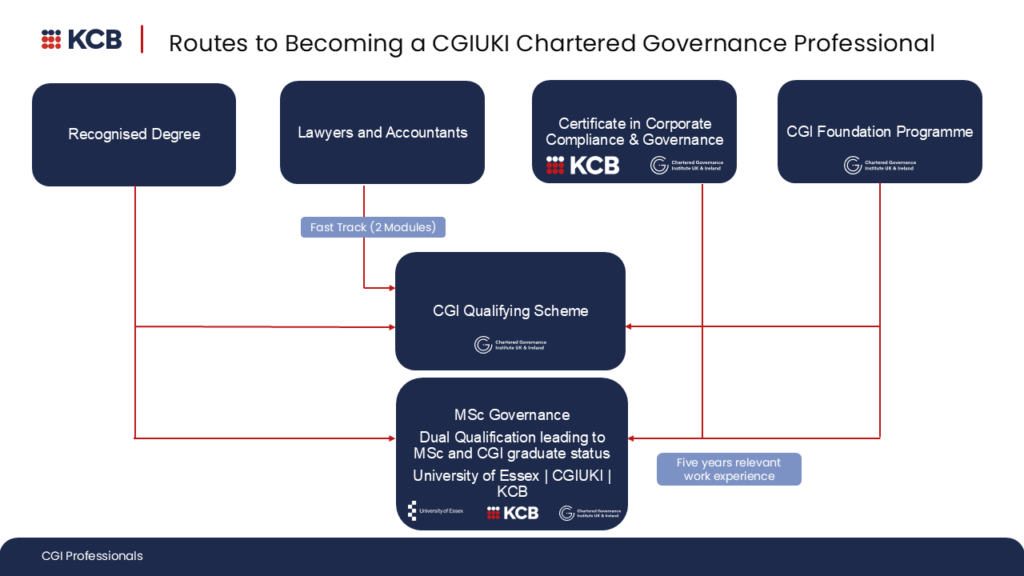
Mauritian students will also gain access to KCB qualifications validated by CGIUKI, including the MSc Governance and the Certificate in Corporate Compliance and Governance. The Certificate, equivalent to the CGI UKI Foundation Programme, provides a practical, career-focused qualification while also meeting the criteria for progression to full professional qualifications.

Neill McWilliams, KCB Programmes Leader, commented:
“Our partnership with Belstar reflects a shared commitment to raising professional standards, broadening educational access, and equipping the next generation of governance leaders. Together, we are  excited to be setting a new benchmark for governance training in Mauritius.”

Tega Appavou, Founder of Belstar Training, commented:
“This partnership enables us to draw upon the expertise of KCB as the leading tuition provider to support students in Mauritius. We are thrilled to be joining forces with KCB Global, and look forward to enhancing our existing programmes and offering new programmes including the Certificate in Corporate Compliance and Governance to be launched in September 2026.”

Start your CGIUKI Certificate in Corporate Compliance and Governance this month!

With just under two weeks to go until the CGIUKI Certificate in Compliance and Governance starts, now is the perfect time to secure your place and take the next step in your governance career. Previously the Certificate of Company Secretarial Practice and Share Registration Practice, this highly regarded qualification is ideal for anyone looking to build foundational knowledge in corporate compliance, governance frameworks and the practical responsibilities expected within organisations today.

Why study corporate compliance and governance?

In today’s evolving regulatory environment, organisations need professionals who understand share registration governance structures, compliance obligations, and ethical best practices. The CGIUKI Certificate in Corporate Compliance and Governance offers a strong introduction to these essential areas, making it a valuable choice for anyone considering progression to the CGI’s professional qualifying scheme, or our MSc Governance.

With a blend of theory and practical application from our experienced tutors, you will be able to instantly apply what you are learning in a real-world context.

What our students say:

I think it was highly valuable and enriching experience. The course provided strong practical and technical knowledge that directly supports my role and career development in corporate governance.

It also strengthened my understanding of best practices, regulatory frameworks, and the responsibilities of the company secretary in a real-world context as I work outside of the UK.


I completed the certificate programme recently, precisely because I felt that I was performing tasks as the company’s secretary for many years without truly understanding what I was doing. I also felt detached and isolated from the very environment of which I was supposed to be a component part.

It had been a while since I had undergone any online learning but my success in the certificate is testament to KCB’s tutoring system, for which I remain very grateful. The course has given me the confidence to take on some of the administrative responsibilities that were traditionally looked after by the company’s solicitor and accountant, with a resulting reduction in the annual estate charges paid by the company’s shareholders/proprietors.


The Corporate Compliance and Governance Certificate at KCB was a fantastic experience. The course content was accessible, and the tutors provided excellent support throughout. It significantly enriched my understanding of compliance and governance and gave me greater confidence in my professional skills. This certificate has also been an ideal stepping stone towards the MSc Governance, which I am also completing at KCB. I highly recommend it to anyone looking to build their knowledge and further their career.


This certification has added clear value to my professional journey, and I am grateful for the quality of content and learning experience. I look forward to continuing my development and becoming a Chartered Company Secretary.

Looking to advance your Governance career? Your next step starts here

Are you ready to take the next step in your Corporate Compliance and Governance career? If you’re interested in starting a career in governance and need a strong foundation before moving on to more advanced professional qualifications, the CGIUKI Certificate in Corporate Compliance and Governance could be the perfect programme for you.

This certificate gives you a deeper understanding of the frameworks, processes and leadership approaches required to support effective governance withing today’s increasingly regulatory and complex organisations. Previously Certificate in Company Secretarial Practice and Share Registration Practice (CCSP), it offers a practical, work-related grounding that prepares you for progression, including entry to the Chartered Governance Qualifying Programme (CGQP).

Why choose the CGIUKI Certificate in Corporate Compliance and Governance?

Delivered by experienced practitioners, you will also have access to guest lecturers and simulations which will build both technical knowledge and practical application, helping strengthen skills in:

  • Compliance management
  • Corporate governance structures and best practices
  • Company administration and legal requirements
  • Effective meeting management and board support

Successful students will be awarded a certificate by the Chartered Governance Institute UK & Ireland. Students are also eligible for CGIUKI Affiliated membership and the use of the post-nominals, ‘CG (Affiliated)’. The Certificate also provides a direct route towards the CGIUKI CGQP, and also KCBs MSc Governance qualification.

Who should enrol?

The certificate is ideal for:

  • Individuals transitioning into governance roles from legal, finance or operational backgrounds
  • Those acting in the role of company secretary and are seeking further knowledge with a practical understanding in the area
  • Individuals who want to ensure good governance and compliance within their organisations
  • Governance assistants, compliance professionals and company secretarial trainees

Programme modules

The Certificate is made up of four core modules:

  1. The Company
  2. Corporate Compliance and Administration
  3. Corporate Governance
  4. Meetings

How does the programme work?

Starting on 16 February 2026, the Certificate programme runs over 12 months, including a summer break, making it manageable alongside work and other commitments.

Key features include:

  • Live online lectures delivered by experienced governance professionals
  • E-leaning you can complete at your own pace
  • Private study guided by a detailed handbook and curated additional reading list
  • Supportive learning community and tutor guidance throughout the year
  • A WhatsApp group to help answer questions and participate in discussions

We recommend this course for those with at least two years previous work experience, or an academic qualification equivalent to at least RFW level 3.

What are the assessments?

There will be three assignments between 2500 and 3000 words, and one examination for this course. These assessments are designed to help you apply governance principles to real-world scenarios, preparing you for the responsibilities of modern governance and compliance roles. Moreover, the exam will help provide you with experience should you wish to take the CGQP in the future.

If you are interested in learning more, email or call Lauren on lauren@kcbglobal.net or 020 7400 0333.

Meet our KCB Tutor: Richard Whitmill

Richard Whitmill, an accomplished Chartered Company Secretary and Fellow of the Chartered Governance Institute UK and Ireland (CGIUKI) is our newest KCB lecturer. With over 15 year of experience in the charity sector, Richard has built a diverse career as a trustee, volunteer and governance professional.

In completing the Chartered Governance Qualifying Programme (CGQP), Richard was awarded the John Phillips Memorial Prize for highest the overall performance on the programme, achieving six distinctions, and the AW Goodbody for outstanding results in the Interpreting Financial and Accounting Information module, scoring an impressive 95%.

We are delighted to welcome Richard to KCB as one of our Tutors for the CGQP Interpreting Financial & Accounting Information module where he brings both his expertise and firsthand insight into how to succeed in this Module that many students find the most challenging.

What motivated you to pursue the CGI qualifications?

Richard: I’d worked in governance for a while, so in many ways, it felt like the most logical next step. I wanted to develop my knowledge of governance as I wanted to know the theory behind what I was doing. When I talked to my employer, we both thought it was quite useful for me to do.

My background is in the charity sector, so I’ve not come from a big team of company secretaries where it feels like there’s a progression route where you do these qualifications. I sort of fell into governance. I hadn’t really, until I was working in governance, heard of the qualifying programme, but I was looking at the next step, and I knew there were some other people in the sector who’d done it. It just felt like it would really level up my governance understanding.

As you now step into a new role as a tutor for the Finance and Accounting module, what do you hope you’re going to bring to your classes, both academically and in terms of student experience?

Richard: I think it’s really important to say I’m not an accountant. I don’t have a finance background, and I dropped maths at school as soon as humanly possible. When I was taking the qualifications, I was really worried about this module, but now I’m teaching it! I actually did well on it, and I hope I can bring some of my techniques for learning.

My whole approach is that it’s a governance module. It’s not about learning to be a bookkeeper or an accountant. It’s about understanding how finances work so that you can advise boards.

Academically, I am going to try to explain concepts simply and focus on the principles. There are calculations that you need to do but my working theory is that if a student understands the principle, then the maths will follow. Anything that’s mathematical we will do step by step, and we’ll do it in a logical way which isn’t reliant on holding lots of figures in your head. I’ll also be honest about what I enjoyed or found difficult, and bring my tips for exam success.

You achieved hugely impressive marks in your exams, and the AW Goodbody and John Phillips Memorial prizes when you took the exams. What do you think contributed to your success?

Richard: Putting in the time. CGI recommend 200 hours, and KCB agree that this time is needed to achieve a merit or distinction.

The importance is to start preparation early, by working at it little and often, and focusing on exam technique. When I took the exams, I tried to understand the course at a very high level to begin with. I asked myself: What is it all about? What are we trying to learn here? It helps to simplify the text into things that you can learn and deploy in the exam. So if you have a chapter with lots of concepts, asking yourself what are the top five things I need to learn?

In my revision, I just practiced. Practice, practice, practice. Use the KCB Companion to practice exam questions, because it not only help you with your exam technique, but it also develops your knowledge will be a huge benefit for the KCB students.

If you could only give students one piece of advice, one thing to take into the exam, what would you tell them?

Richard: Believe in yourself. It’s very cheesy, but you’ve done the work, you’ve had access to KCB tutors, the KCB LMS [Learning Management System] and the Companion Examination Practice Tool . When you’re in the exam it’s easy to be scared, but actually, if you’ve done the work you’ve got that knowledge. So believe in yourself, back yourself.

In practice, that means attempt each question, and write as you start thinking about it logically. Your knowledge will come to you, and don’t leave any question unanswered because you can’t get marks from blanks.

Have you found that having the qualification has helped you navigate governance complexities in your day-to-day job?

Richard: 100%. It has been so useful. I think when I signed up, I was interested in the technical side of things. I thought I needed to know how to write resolutions and run meetings and so on. It’s been helpful for that, but the fact it goes beyond that and helps you actually, really, properly, strategically advice a board is great. In the last year it’s helped me strengthen risk management from the Risk Management module. It’s helped me understand board dynamics, and facilitate away-day sessions and navigate dynamics between board members.

For the module I’m teaching [Interpreting Financial and Accounting Information], that’s also been really helpful for my role. Being able to read a set of accounts and understand what’s going on in detail helps you understand what’s happening in the company, but also support the board and provide context to explain to board members without a financial background what’s going on.

Why do you consider the CGQP pathway to be such a critical foundation for aspiring governance professionals?

Richard: I think they’re important because, firstly, recognition. They’re a mark of quality. They show the boards you support or potential employers, that you know your stuff and you’ve got an internationally recognised qualification. Going back to what I was saying earlier, they give you such a good grounding in how governance works across lots of areas, and they give you the technical knowledge to be able to do your day to day job well. I think someone’s referred to it as a mini MBA, with a focus on governance, and that gives you an understanding about how companies run. The soft skills you get are really helpful. It starts help making you think how to be a strategic advisor and a confidant to the board, and not just someone who does the filing.


If you’d like to register for Richard’s Interpreting Financial & Accounting Information CGQP course, register here.

Weekly vs Flexible CGQP courses: Which study option is best for you?

Picking the best CGQP course option that fits your needs is important because it will give you the best chance for success and passing your CGQP exams. At KCB we are here to support you in finding the most affective CGQP exam preparation course for you and your studying patterns.  

KCB is here to guide you through every step of the complex CGI examinations. With consistently high pass rates across all our courses, we focus on strengthening your knowledge, time management and exam techniques. Through dedicated mock examinations, the KCB Companion Examination Practice Tool, personalised feedback, and ongoing tutor support, we’ll help you stay motivated and fully prepared to succeed.

How to choose the right CGQP study plan for you

We’re excited to offer both Weekly and Flexible CGQP programmes, designed to match your study style and goals. Weekly courses are ideal for learners who thrive on structure and live interaction, while flexible courses, available only for part 1 modules, suit those who prefer self-paced learning. Use our guide below to compare options and choose the plan that’s right for you.

Comparison table for differences and similarities between the weekly and flexible CGQP courses at KCB.

Both our Weekly and Flexible CGQP courses include access to KCB’s Companion Examination Practice Tool. This is a powerful resource designed to boost your exam success. Consistent practice is essential, and this tool helps you refine your technique and build confidence for top results. Click the link above to learn more about our game-changing tool.

How soon can I start?

Our weekly modules will start in March with live online classes held in the evening (UK time) for convenience to fit around work commitments.

Our flexible modules will be available from 2 February 2026, via our Learning Management System. Please note that flexible courses are only available for part one modules.

Explore our weekly and flexible options today, and take our handy quiz to find out which course is the best CGQP course option for you. If you want to discuss your options, contact our Programme Manager, Lauren (lauren@kcbglobal.net)

Introducing KCB’s Companion Examination Practice Tool for CGQP Exam Success

KCB is delighted to announce the official launch of the KCB Companion Examination Practice Tool, designed to support our students throughout their Chartered Governance Qualifying Programme (CGQP) journey. All students enrolled in any KCB study package will receive exclusive access to this powerful new resource to ensure confidence with excellent examination skills.

What is the KCB Companion Practice Examination Tool?

The Companion includes an extensive bank of all past CGI examination questions, allowing students to target their practice with precision and build confidence as they progress towards their exams. It tests knowledge in a timed environment, replicating exam conditions. Access to the full bank of CGI questions, combined with the opportunity to practice timing, structure, and exam‑style responses, will help KCB students strengthen their examination technique and improve their chances of success.

Students can use the tool for three types of practice throughout their studies:

  1. Selfdirected practice: Students can create their own practice tests to revise in their own time and focus on areas they need to strengthen
  2. Tutorset tests: Tutors will set tests for students to complete between classes, and will provide additional feedback to develop the AI’s response
  3. Mock examinations: Students will complete mock exams at defined points in the course to ensure they are on track with their studies and feel confident as the exam period approaches

How does the Companion support CGQP exam success?

The Companion provides instant marking and feedback, helping students identify strengths and areas for improvement. The immediate insights are followed by personalised feedback from our experienced tutors, ensuring students receive the guidance they need to refine their techniques and deepen their understanding and skills. The combination of the Companion and our tutors’ expertise directly supports students in achieving exam success.

Screenshot of KCB Companion Examination Practice Tool for CGQP exam preparation

To help students understand their performance at a glance, the Companion uses a traffic‑light marking system. This highlights the areas answered effectively and which subjects require further practice. By strategically targeting their revision, students can prepare confidently for their exams.

What our students say about the Companion

During our pilot for the Companion, our students responded positively, saying

“Thank you so much for developing such an incredible tool… having the opportunity to prepare in this way was massively supportive in the run up to the exam and I felt like I had better exam technique on the day as a result.”

“The tool is easy to use, and super helpful for exam practice.”

“It’s really good, and the nearly immediate feedback was especially helpful to gauge my understanding and performance.”

“I found the AI feedback good and the tool easy to use.”

We are excited to offer this innovative resource to all students registered on both our weekly and flexible CGQP courses. With the support of the Companion and the expertise of our dedicated tutors, we are confident that our students will feel empowered, motivated, and ready to excel in their exams. Learn more about our CGQP weekly and flexible courses, or get in contact with our Programme Manager, Lauren (lauren@kcbglobal.net)